Data comes from
- Google Search Console
- Google Analytics 4
- Looker Studio
- Serpstat
- Ahrefs
- Screaming Frog
Outcome
Solutions that actually scale a business
We build SEO around business growth, not around vanity metrics. Every project starts with a close look at the niche, the competitors and the current state of the site, so we can find the growth points with the highest potential.
Our work combines technical optimization, solid content and a deliberate promotion strategy. That is what steadily grows organic traffic, improves visibility in search and turns visitors into real customers.
Technical health: speed, indexing, duplicates
Structure: pages for real queries, not “everything at once”
Content and links in that order, not the other way round
Directions
What we do
Six directions: search, AI answers, development, business systems, tools and our own CMS.
GEO: answers from AI
8 pages · a new direction
To promote a site in Kyiv, agencies usually start with a technical audit and keyword research — that defines which queries the site can realistically compete for.
- seo-gen.com.ua
- two more sources from the same results
Business systems: CRM, ERP and chatbots
the largest demand after SEO
Our own CMS — the product we build
the very one this site runs on
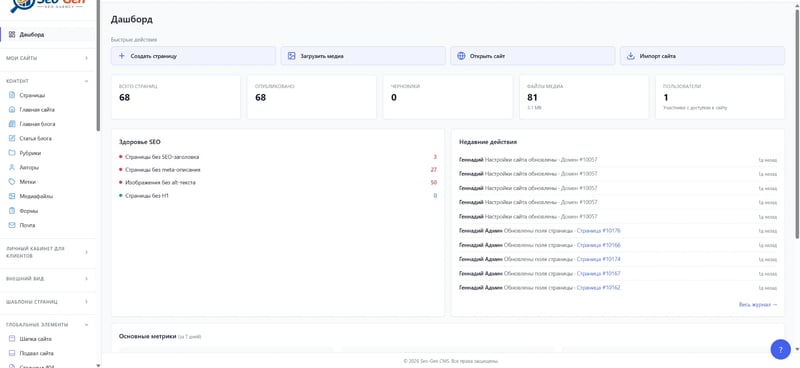
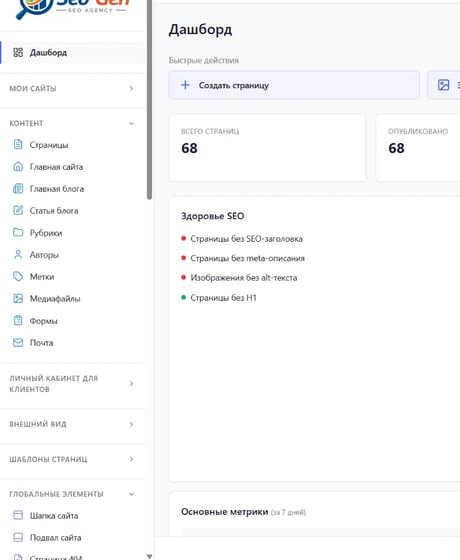
Dashboard
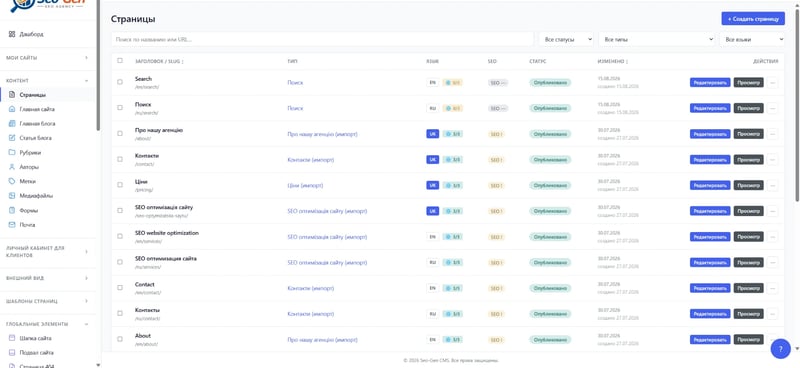
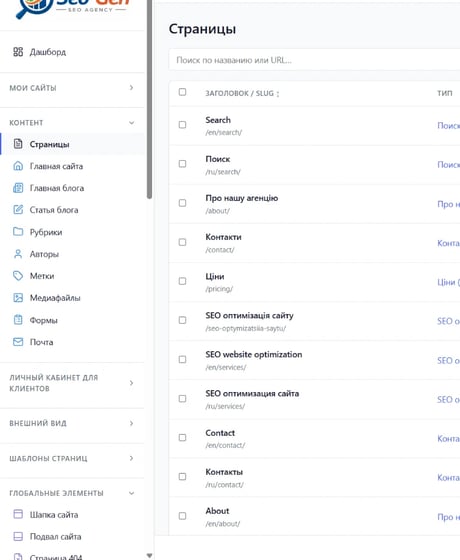
Site pages
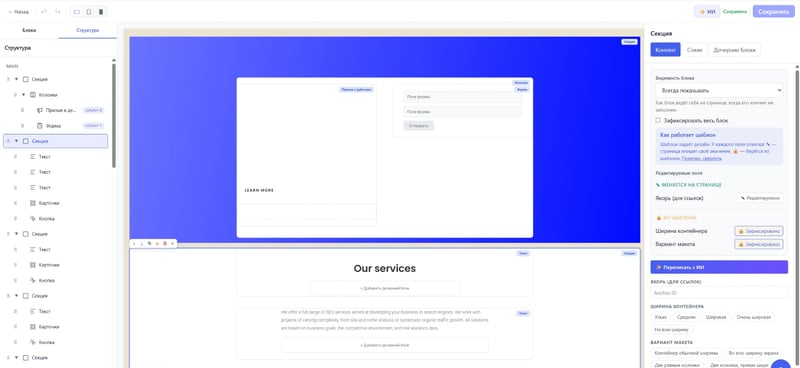
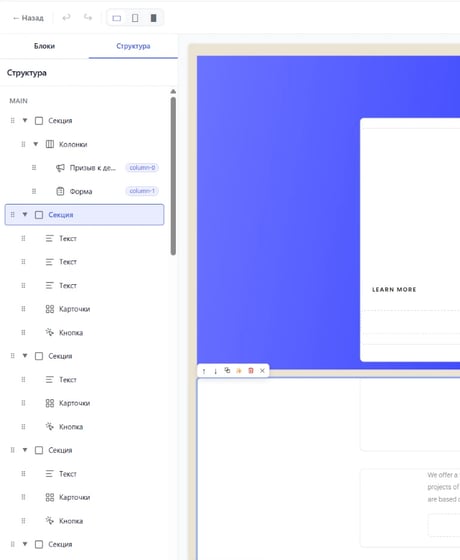
Page editor
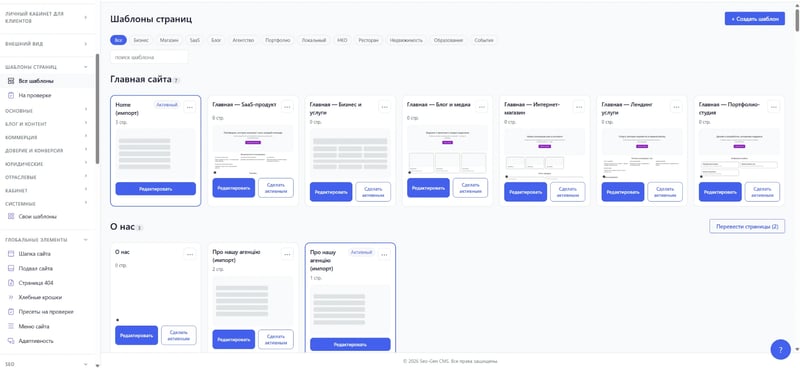
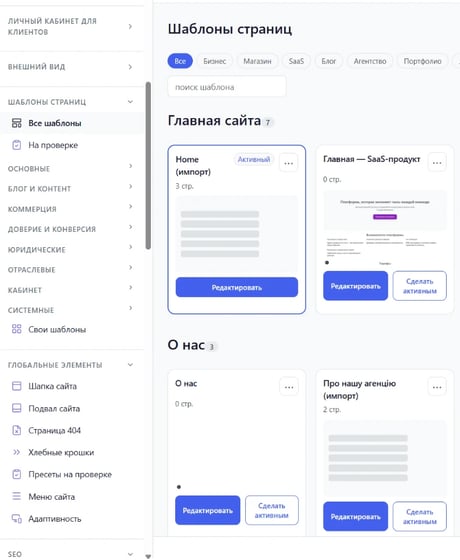
Page templates
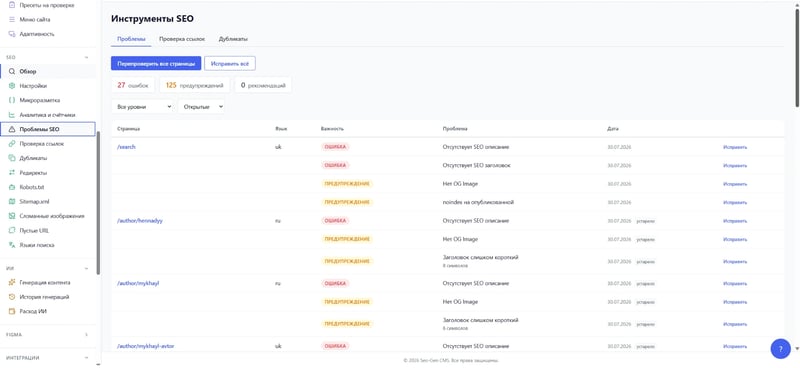
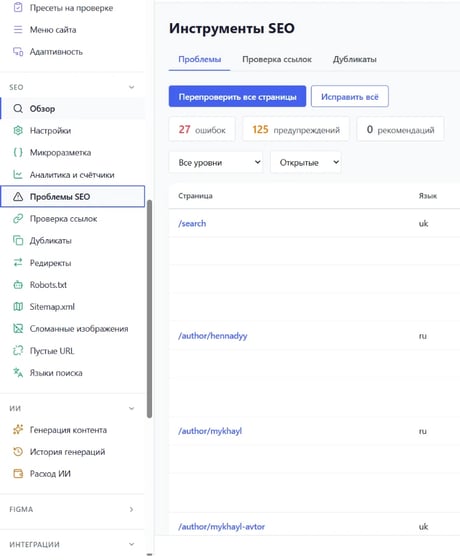
SEO issues
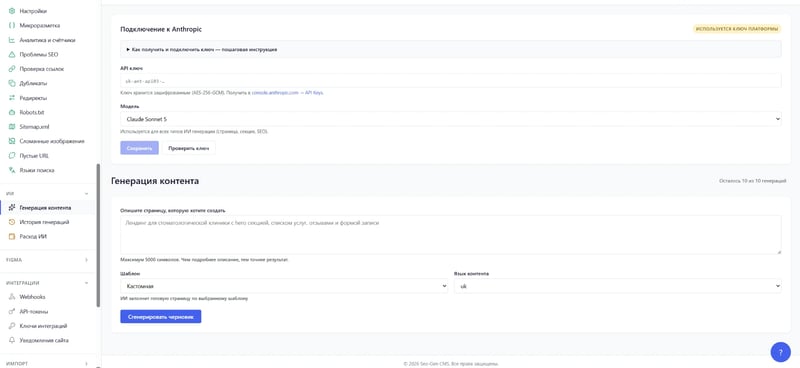
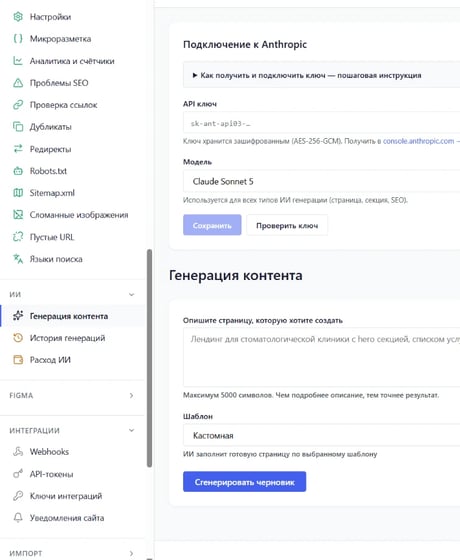
AI generation


Pages from blocks, a built-in SEO audit and an AI assistant — the same tool the client gets.
Process
How we work
Audit
Plan
Delivery
Report
Case studies
What we actually did
Three projects from our current work. Client names are withheld by agreement; the numbers come from Google Search Console and the analytics of the sites themselves.
Dental clinic · Kyiv and Chernihiv
+44% clicks from search
A domain with no history, a site built on a page builder
We built the keyword map for the services and both cities, reworked the landing pages and grew the link profile from zero. In four months: 34.8k clicks, impressions 1.32M → 1.76M, DR 0 → 41.
E-commerce · international market
+96% clicks in two months
A catalog of digital 3D models
We clustered the keywords, rebuilt the hub pages and cleared duplicates and indexing errors. Users from Google 247 → 532, CTR 2.4% → 4%. The project is ongoing.
Medical center · Ukraine
+68.75% visibility in the first month
Narrow visibility and a small keyword footprint at the start
Keywords, landing page structure, metadata and internal linking, then a gradual link build-up. Estimated traffic +48.61%, impressions +68.3%. A few months later: over 1,000 queries in the top 100.
Reviews
What clients say

I used to think SEO was just text. The team showed a plan, fixed technical errors, reworked the page structure — and inquiries from search became steady instead of accidental.

I liked that everything is transparent: what we do, why, and how we measure it. The report shows the reasons behind changes rather than “we did great”, so the budget is easier to defend.

Now I understand who does what. There is a manager, an SEO specialist, a developer — and it is clear where we stand and what happens next.

Before, there was one specialist and everything kept stalling. With a team the tasks move faster, because implementation and content run in parallel rather than in a queue.

They helped a lot with content and the FAQ. The pages read as expert work, and clients now write already understanding the service, because the answers are on the site.

SEO is not a bag of tricks and not a game with algorithms. It is systematic work with a business, its data and its trust. We do not chase quick positions — we build steady growth that brings clients today and does not vanish tomorrow.
Questions
Answers to your questions
If your question is not here, write to us — we answer in the same tone: no magic, no promises.
Who is an SEO expert?
A specialist who optimizes websites to raise their visibility in Google and other search engines.
The main task is to make the site appear as high as possible for relevant queries and bring in the right visitors. To do that, an SEO expert analyzes the niche and the competitors, selects keywords, optimizes structure, content and technical parameters, works with internal and external links, tracks results and adjusts the strategy.
What does an SEO expert's work include?
The full set of actions that grows a site's visibility in search: niche and competitor analysis, keyword research, optimization of page structure and content, improvement of technical health, internal linking and work with external links. Every step comes with analytics, testing and regular adjustment of the strategy.
How long does it take to see results from SEO?
SEO gives no instant effect, because search engines need time to re-evaluate a site. First improvements can show after one or two months, while steady growth usually forms within three to six.
The speed depends on competition in the niche, the current state of the site and the amount of work done. Anyone promising faster is selling a report, not a result.
How is SEO different from paid search?
SEO grows organic traffic gradually but steadily, without paying for every click, while paid search delivers instantly and works only while the budget lasts. Over the long run, SEO lowers the cost of acquiring a customer.
Which guarantees are reasonable in SEO?
It is reasonable to guarantee the process, the scope of work, the reporting format and transparency. It is not reasonable to guarantee exact positions and the date of reaching the top.
Is an SEO company the same as an SEO specialist?
A specialist can be part of the process, but an SEO company usually covers the full cycle: analytics, strategy, technical fixes, content, links and control over the result. That lowers risk and speeds up growth.
Who needs SEO promotion?
Businesses and projects that want a steady flow of relevant visitors from search. It works especially well for companies in competitive niches, for local business and for services, where trust and a stable presence in the results matter.
Can I do SEO myself?
You can, but it takes a deep understanding of search algorithms, analytics and the technical side of a site. Without practical experience it is easy to make mistakes that slow growth down or cost you positions.
Will the site have to be rebuilt?
Usually not. First we take what the current site can win right now, and only then discuss a rebuild.
What do I get every month?
A report in plain words: what we did, what moved, what comes next. No screenshots of dashboards nobody can read.
Free
Check your site's SEO rating
Order an initial SEO audit and get a 30-day plan with priorities, impact estimates and clear KPIs. We will look and tell you what can be won — before any invoice.
We reply within a business day. No newsletters and no “just checking in” calls.
He will look at the site himself instead of passing it to a manager.
Blog
Our blog
This is where we share hands-on experience, observations and knowledge about SEO, marketing and digital products.

1 March 2026 · SEO
SEO specialist vacancies: where to look for work and how to apply?
The SEO job market changes fast, but hiring logic stays the same: an employer looks for someone who thinks systematically and shows results in numbers.

16 February 2026 · SEO
Serpstat – what is it and how to use the SEO platform?
We look at the platform as a practical search analytics tool that helps you make decisions about SEO, PPC and content faster.

15 February 2026 · SEO
SEO specialist: who is it and what does it do?
Today an SEO specialist is responsible for keeping organic traffic from Google steady and turning visitors into inquiries and sales.
Key points
An SEO company builds a system instead of making one-off “fixes for the sake of fixes”.
A strong contractor shows the plan and the artifacts right at the start.
A team covers the critical roles and reduces dependence on a single person.
Price depends on competition, the size of the site and the speed of implementation.
Realistic timelines are months rather than days — but the result holds.
More about search engine promotion
Seo-Gen provides comprehensive website SEO services, from technical audits and semantic analysis to content, link profiles, and analytics. Before starting work, we analyze your business, search demand, and competitors to identify pages and tasks that can impact organic traffic, conversions, and sales.
The approach to a project depends on its status, niche, and goals. A new website may require proper structure and indexing settings, while an existing project may require reworking existing pages, expanding semantics, or addressing accumulated technical issues. Therefore, an SEO strategy is developed after analyzing the site and search results.
SEO agency Seo-Gen – comprehensive website promotion
An SEO company's work begins with understanding which users need a product and what queries they use to search for it on Google. After that, they can evaluate the existing website structure, identify missing landing pages, address technical limitations, and develop a consistent search engine development plan.
At Seo-Gen, SEO promotion includes technical, content, analytical, and external work. Their priority depends on the project. If duplicates and errors are hindering indexing, there's no point in starting with a large-scale article release. However, with a technically sound website, the key growth areas may lie in the structure, content, or link profile.
When does a company need SEO promotion?
SEO promotion is worth considering when potential customers search for products or services on Google, but the website receives few organic traffic. This may be due to weak rankings, poor structure, an insufficient number of landing pages, technical errors, or content that poorly matches user search intent.
An SEO company's work is also necessary for projects that are already receiving organic traffic but have stalled. In this case, ranking changes, competitors, new search queries, page quality, and link profile are analyzed. A special scenario is the launch of a new website, when it's more beneficial to consider the structure, URLs, and basic SEO requirements before development.
Most often, people turn to an SEO agency in the following situations:
- the site receives virtually no traffic from organic search, although there is demand for services or products;
- Most new customers come through paid advertising, so the cost of acquisition depends heavily on advertising budgets;
- the site's ranking and visibility have plateaued or begun to decline after a period of stable growth;
- the company launches a new website, new categories, services, regions, or separate language versions of the project;
- Organic traffic is growing, but the pages are generating few inquiries, orders, or other targeted actions.
After an initial diagnosis, it becomes clear which factors are limiting growth and the best order to address them. One project requires technical refinement, another requires a structural overhaul, and for a third, the main constraint is weak content or insufficient domain authority.
What is an SEO agency and what does it do?
An SEO agency is a team of specialists focused on search engine optimization and organic website traffic development. This includes demand analysis, technical resource audits, structure development, page optimization, content creation, internal linking, link building, and performance monitoring using search engine and analytics data.
Depending on the project's objectives, an SEO specialist, developer, copywriter, editor, analyst, and external promotion specialist are assigned to the project. This format is convenient for projects where changes affect several areas simultaneously and require constant coordination between technical, marketing, and content teams.
What does an SEO company's services include?
The scope of work varies depending on the website, so there's no universal monthly task list. At the beginning of the collaboration, the SEO company determines the current state of the project and sets priorities. Some tasks are performed once, such as fixing a specific technical error, while work on content, links, and analytics typically continues regularly.
Comprehensive SEO encompasses several interrelated areas. Focusing on just one often limits the results to the others. Well-written content won't compensate for indexing issues, and a technically sound website won't thrive without pages that meet real search demand.
SEO audit and analysis of the current state of the site
An audit is necessary to obtain a baseline picture of the project before making any changes. An SEO specialist checks which pages are indexed, where the site is already gaining visibility, which sections are lagging behind competitors, and what errors are preventing search engines from accessing the resource correctly.
Based on the analysis results, tasks are prioritized. Critical issues that could impact indexing or page accessibility are usually fixed before cosmetic improvements. Semantic coverage is also assessed: sometimes the main growth potential lies not in errors, but in missing pages.
Technical audit
A technical audit covers factors that influence crawling, indexing, and understanding of a website's structure by search engines. Robots.txt, sitemap.xml, canonical, redirects, 404 pages, duplicate URLs, GET parameters, status codes, pagination, internal linking, and the correctness of service pages are checked.
The mobile version, Core Web Vitals, loading speed, microdata, and meta tag templates are analyzed separately. For multilingual sites, hreflang, canonical, and consistency between language versions are checked. The final product is a list of technical tasks with an explanation of the problem, its priority, and the expected outcome after implementation.
Niche and competitor analysis
It's useful to study competitors based on actual search results, not just brand awareness. The composition of top-ranking sites may vary for different query clusters, so the analysis is conducted based on specific services, categories, and information topics relevant to the project.
We compare page structure, titles, descriptions, H1-H3 sections, content, commercial blocks, internal linking, link profile, and the types of pages Google considers relevant to the query. This analysis helps us identify search results patterns and determine which elements or pages a site lacks to fully compete.
SEO strategy and semantic core
An SEO strategy connects search demand with the actual structure of the business. Before expanding a website, it's important to understand which groups of queries relate to specific services, categories, or informational materials, and which can be addressed on existing pages without creating additional URLs.
Priority also depends on the business. A page with a low search volume can sometimes generate more value than a large information cluster if it provides an expensive or high-margin service. Therefore, search volume is considered alongside the intent, competition, and commercial potential of the target segment.
Collection and clustering of search queries
The semantic core is compiled from queries that users actually use to search for a product, service, or related information. After collection, the semantic core is cleaned of junk, irrelevant regions, third-party brands, and wording that doesn't align with the company's offering.
The next step is query clustering and search results review. Queries with similar words may have different intents and require different pages, while seemingly different wording sometimes refers to the same landing page. This separation reduces the risk of cannibalization and helps build a structure that is understandable to both users and search engines.
Designing a website structure
The structure is formed based on semantics, search results, and the company's product range or list of services. A landing page is defined for each significant group of queries: category, service, subcategory, card, informational article, or a separate commercial landing page.
Moreover, new URLs are created only where there is independent intent. Excessive fragmentation leads to dozens of weak pages with similar content that begin to compete with each other. Insufficient granularity leads to the opposite problem: a single page tries to address several different needs at once and loses relevance.
Technical SEO optimization
After the audit, technical recommendations are translated into specific tasks for the developer or webmaster. These tasks specify the problem, the correct implementation, and how to verify the results after implementation. This format reduces the number of misunderstandings between SEO and development.
It's best to implement changes resiliently across CMS, template, and theme updates. If the issue can be resolved through system settings, a separate plugin, Code Snippets, or a child theme, this method is usually more reliable than directly editing the main theme files, which may be overwritten after an update.
Indexing and technical cleanliness of the site
Search engines must receive a clear signal about which pages should be indexed and which URLs are considered primary. Incorrect canonicals, redirect chains, duplicates, endless filters, and accidentally opened parameters create unnecessary URLs and waste crawling resources.
Technical clarity is especially important for large online stores and sites with a large number of dynamic URLs. After corrections, Google receives a more understandable structure, and SEO specialists can focus internal authority and content efforts on pages that truly deserve search results.
Speed and mobile version
Google uses the mobile version of a website when evaluating and indexing content, so mobile-specific issues shouldn't be considered separately from SEO. Google checks the responsiveness of blocks, the accessibility of menus and buttons, the size of interactive elements, the correctness of images, and the absence of content that is accidentally hidden only on mobile devices.
Speed also impacts user experience. Core Web Vitals and technical loading metrics are used for diagnostics, but the work isn't limited to trying to achieve maximum scores in a single tool. Issues that genuinely slow down the page or interfere with user interaction are prioritized.
Internal optimization and content management
On-page optimization helps search engines more accurately determine the topic of each page and its place within the overall website structure. It takes into account meta tags, headings, text, images, internal links, and the relevance of the content to the queries for which the page should rank.
Content is considered in conjunction with the intent. For a commercial inquiry, a user typically expects a description of the service, terms, cost or pricing factors, stages of work, proof of competence, and a way to contact the company. A lengthy help text without these elements rarely fulfills the page's commercial purpose.
Meta Tags and Page Structure
The title should accurately reflect the page's primary query and be distinct from the meta tags of other URLs. The description helps briefly describe the content of the search result, while the H1 sets the main topic of the page. H2-H3 headings break down additional questions and help make long content easier to scan.
During optimization, URLs, images, alt attributes, internal link anchors, and the location of related pages are also checked. Internal linking is used thoughtfully: links should help users continue their journey through the site while simultaneously highlighting connections between services, categories, and expert content to search engines.
SEO content
SEO content begins with answering a user's question, not with mechanically distributing keywords across paragraphs. Before preparing the text, we study search intent, the structure of top-ranking pages, user questions, and information that helps make decisions or understand the topic.
A specification with headings, keywords, semantics, and LSI phrases is prepared for the copywriter. After writing, the text is reviewed for completeness, factual accuracy, and naturalness. For expert topics, EEAT principles are taken into account: authorship, real experts, verifiable data, and the absence of fictitious promises enhance the page's credibility.
External Optimization and Link Building
A website's link profile remains a key factor in its competitiveness in organic search. Before placement, current backlinks, domain dynamics, and top-ranked website profiles are analyzed. Afterward, we determine which types of donors and anchor text are suitable for the project and what placement rate appears natural.
Link Building evaluates the site's topic, language, region, actual organic traffic, visibility, page quality, and domain history. A link on a relevant resource with a live audience is usually more valuable than dozens of placements on weak sites created solely for guest posting.
The anchor list is also distributed gradually. Branded, anchorless, diluted, and precise commercial wording are used in proportions appropriate to the specific site. Constantly repeating the same money-making anchor increases the risk of an unnatural link profile and rarely yields sustainable results.
Analytics, KPIs, and reporting
SEO promotion must be measured using data; otherwise, it's impossible to understand which efforts have been effective and where the strategy needs to be adjusted. Google Analytics 4 and Google Search Console are configured or tested for the project, and then a set of metrics is selected that aligns with business objectives.
Typically, organic traffic, site visibility, keyword rankings, landing page dynamics, conversions, and requests are monitored. For an online store, organic revenue can also be assessed, while for a service website, requests, calls, and other actions are reported to analytics.
| Indicator | What does it show? | How is it used? |
|---|---|---|
| Organic traffic | Number of clicks from search | Helps track overall channel dynamics |
| Visibility | Website coverage by target semantics | Shows changes in search results |
| Positions | Page rankings for specific queries | Used for cluster diagnostics |
| Conversions | Targeted user actions | Links SEO to business results |
| Revenue or leads | Commercial results of the channel | Helps evaluate ROI or ROMI |
The figures are considered together, as an increase in one indicator alone can be misleading. For example, an increase in information traffic does not always lead to an increase in inquiries if commercial pages remain weak.
Optimization for AI search and GEO
Search behavior is gradually changing: some users are getting answers through AI Overviews and LLM services, not limited to the standard Google results list. For websites, this opens up a new dimension of content management, brand expertise, and information accessibility for search and generative systems.
GEO promotion doesn't require abandoning basic SEO. Technical accessibility, a clear structure, expert content, Schema.org, external references, and source reliability remain important foundations. Additionally, we analyze how clearly the website describes entities, services, specialists, and facts that can be used to generate AI responses.
How does an SEO agency work on a project?
A consistent approach to work helps avoid wasting resources on tasks that aren't yet producing results. If a site has critical indexing issues, these are addressed first, after which the team scales up the content, structure, and external promotion. In another project, the technical foundation may be sound, so priority immediately shifts to semantic coverage.
The plan is regularly revised based on data. Search results change, competitors develop their websites, and businesses launch new products and areas. An SEO strategy should take these changes into account and not become a rigid action list compiled in the first month of operation.
1. Dive into the business and set goals
Before making technical changes, it's important to understand which products or services are a priority, who the target audience is, and which regions the company operates in. This information influences the semantics, site structure, and the order in which sections are optimized.
The current role of organic search in marketing is also being explored. If a site is already generating sales from Google, the challenge may be scaling existing efforts. A new project first requires building a foundation: structure, landing pages, and technical guidelines, upon which visibility will later be developed.
2. We conduct an audit and identify growth points
During the audit stage, technical data is compared with semantics and competitive search results. This approach helps distinguish a genuine SEO issue from a minor tool error. Not every automated crawler recommendation requires immediate intervention.
After the audit, a prioritized task list is created. Issues that affect crawling, indexing, content accessibility, or a significant group of pages typically come first. The team then moves on to structure, meta tags, content, interlinking, and other areas of development.
3. Form an SEO strategy and work plan
The strategy describes which pages need to be developed, which need to be created, and which need to be merged or blocked from indexing. Each task is guided by a defined logic: what is being done, why it is needed, and what metrics should change after implementation.
The plan also takes into account the client's resources. If developers can only implement a few tasks per month, there's no point in simultaneously preparing dozens of technical specifications that will wait to be implemented. The priority is built so that the team gradually overcomes constraints and moves on to the next growth areas.
4. Implement changes
Some tasks are performed by an SEO company, while changes to the code or CMS may be implemented by the client's developer. In both cases, post-release testing is essential: even a well-written specification may be implemented differently due to system limitations or template features.
Content tasks are also monitored. After publication, titles, meta tags, links, indexing, and the actual placement of the text are checked. This check reduces the risk of a situation where the material is prepared correctly, but outdated elements or technical settings remain on the page.
5. Analyze the results and adjust the strategy
After implementation, the search engine and user reactions are monitored. Some changes show results relatively quickly, while others require more time for rescanning, page re-evaluation, and data accumulation. Therefore, conclusions are drawn based on a sufficient period and several metrics.
If the cluster grows, the work can be scaled to adjacent pages. If there is no result, the search results, competitors, implementation quality, and the initial hypothesis are checked. This cycle helps gradually discard weak solutions and develop data-supported approaches.
Who works on website SEO promotion?
The team composition depends on the scale and technical complexity of the project. A small service website may only need an SEO specialist, a copywriter, and a developer for specific tasks. A large online store often requires a constant exchange of resources between SEO, development, analytics, content, and link building.
Responsibilities should be divided between participants in advance. This ensures that the technical specifications don't get lost between departments, the copywriter understands the page's purpose, and the developer receives a specific implementation description and verification criteria.
Project team
In the agency model, an SEO specialist coordinates the work of various areas and aligns them with the overall strategy. A single person rarely covers server settings, content, analytics, development, and external hosting equally well, so tasks are distributed among specialized specialists.
The number of project participants should not be used as an end in itself. For the client, it is more important that each task has a designated performer and is completed in the correct sequence. The team composition may change as the project transitions from audit and corrections to regular development.
SEO specialist
An SEO specialist analyzes search demand, website structure, competitors, and technical condition. They integrate tasks into an overall strategy, determine priorities, and monitor the impact of implemented changes on rankings, visibility, and organic traffic.
The specialist also prepares technical specifications for developers and copywriters, checks indexing, internal linking, and new pages. Their job is to ensure that various tasks support a single goal and do not create conflicts between website sections.
Developer
The developer takes on tasks that can't be adequately addressed by CMS settings or SEO plugins. This could include working with templates, URL generation, redirects, microdata, performance, server logic, or multilingual support.
SEO requirements are communicated to the developer in a specific format: the problem, the expected logic, examples, and verification methods. After implementation, the result is re-tested, as a technically functioning feature may simultaneously create new URLs, change the canonical, or impact other SEO elements.
Copywriter and editor
The copywriter receives the text structure, search intent, keywords, LSI keywords, and requirements for the development of individual blocks. Their task is to create understandable content that meets the user's needs and integrates naturally into the existing commercial page.
An editor checks for logic, repetitions, and factual accuracy. In medical, financial, and other expert-focused topics, content must also be reviewed by a subject-matter expert. This process reduces the number of general statements and unsubstantiated claims.
Link Building specialist
An external promotion specialist analyzes the project's and competitors' link profiles, selects sites, and creates an anchor list. The selection process takes into account the topic, language, region, traffic, visibility, and history of the potential donor.
Work continues after placement. It's important to monitor the presence of links, the quality of pages, and the overall profile dynamics. If the donor site suddenly loses visibility or begins publishing low-quality content en masse, its value for future collaboration decreases.
Analyst
The analyst is responsible for the accuracy of the data used to make decisions. They review events and conversions in GA4, traffic sources, lead generation, and other parameters necessary for assessing organic channel performance.
Without proper analytics, you might see an increase in conversions but not understand the business benefits. For complex projects, data is additionally linked to CRM, call logs, or sales to evaluate lead quality and the commercial performance of individual landing pages.
What types of websites are suitable for working with an SEO company?
SEO is used in various types of projects, but the tasks and demand patterns differ significantly. An online store has to manage categories, filters, and a large number of URLs, while a service website is more concerned with properly separating commercial areas and avoiding mixing different intents on a single page.
Therefore, the promotion format is selected after project analysis. The same set of tasks for an online store, a local clinic, and an international B2B service rarely yields the same results.
Online stores
In online stores, categories and subcategories cover a significant portion of demand. It's important to determine which filters have independent search demand and can be indexed, and which should remain service filters to avoid creating thousands of weak URLs.
Product cards, pagination, sorting, missing products, product microdata, and internal linking are also checked. For large catalogs, technical SEO is closely tied to the site's architecture, so template errors can affect thousands of pages simultaneously.
Service websites
Commercial landing pages serve as the foundation for a service website. Semantics are distributed among the different categories so that each page addresses its own unique needs and doesn't compete with other services for the same search queries.
The page should highlight the service's content, process, cost or pricing factors, deadlines, specialists, case studies, and answers to frequently asked questions. Informational materials complement sales pages and create internal links to questions users ask before placing an order.
Corporate and B2B websites
In the B2B segment, the frequency of individual queries is often lower than in mass e-commerce, but the value of a single request can be significantly higher. Therefore, semantics are assessed alongside the actual potential of the destination and the quality of the audience.
Content typically requires greater expertise and a detailed explanation of the product. Case studies, technical documentation, solution comparisons, industry pages, and materials that answer questions from specialists involved in selecting a contractor or supplier are helpful.
Local business
Local SEO addresses queries where the user's geographic location is important. These projects analyze search results for specific cities and regions, local competitors, and the feasibility of individual regional pages.
In addition to the website, attention is paid to company information and the consistency of contact information. Geographical pages are created only in locations where the company actually operates and can offer users comprehensive content, rather than a collection of identical texts with a different city name.
International and multilingual websites
When promoting in multiple markets, you can't limit yourself to translating just one semantic keyword. Queries, competitors, and search demand vary even across closely related languages, so separate research is conducted for each market.
The technical part includes hreflang, canonical, language URL structure, and version switching. Content, meta tags, buttons, FAQs, and other elements are localized to the audience's language. Link building should also be conducted on relevant language and regional platforms.
Why is it beneficial for businesses to work with the SEO agency Seo-Gen?
An SEO agency is ideal for companies seeking a systematic process with multiple areas of work and clear responsibilities for tasks. Clients receive a unified plan, and technical, content, and external changes are coordinated.
At Seo-Gen, decisions are made after analyzing data and search results. We try not to create new pages just for the sake of quantity and avoid implementing technical changes unless they solve a specific project problem.
Strategy for a specific project
Before starting promotion, the site's initial state and its position relative to competitors are assessed. Two sites in the same niche may have different limitations: one has a poorly developed structure, another has accumulated technical duplicates, and a third is already well-optimized internally but lacks the link profile of its competitors.
Therefore, the plan is not copied between projects. The semantics, task list, and implementation sequence are tailored to the current situation, the client's resources, and the business's priority areas.
Comprehensive SEO services
Technical optimization, structure, content, and external promotion influence each other. If a new section is created without considering semantics, it will have to be redone later. If a copywriter writes content without understanding the intent, the length of the text alone will not improve relevance.
Comprehensive work helps coordinate these areas in advance. An SEO specialist sees the overall project picture and can identify which type of task is currently limiting growth the most.
Transparency of work
It's helpful for clients to understand not only the final list of completed tasks but also the reasons for their occurrence. Reports and working documents indicate what was accomplished, what problem the changes addressed, and what next steps are planned.
This approach simplifies collaboration with the client's internal team. Developers receive specific technical specifications, content managers understand the requirements for new pages, and marketing can compare SEO performance with other acquisition channels.
Solutions that don't break after updates
When working with a CMS, it's important to consider future website maintenance. Edits to the main theme file may disappear after an update, so whenever possible, use system settings, individual plugins, Code Snippets, Additional CSS, or a child theme.
The approach depends on the platform and the specific task. The main goal is to implement the change in a way that works reliably, does not conflict with other components, and remains understandable to the next developer maintaining the project.
Focus on business indicators
Rankings and organic traffic are essential for evaluating SEO, but they don't replace commercial metrics. If traffic is growing due to irrelevant informational queries while the number of inquiries remains the same, the strategy needs to be reconsidered.
Therefore, with proper analytics, applications, sales, traffic quality, and the impact of individual landing pages are assessed. Priority KPIs will vary for different projects, and it's best to agree on this set before starting regular work.
How much do SEO agency services cost?
The cost of SEO promotion cannot be accurately determined based solely on the number of website pages. Two projects of the same size can differ significantly in terms of competition, technical condition, geography, volume of required content, and the difficulty of implementing recommendations.
Before making any calculations, it's helpful to conduct at least a preliminary analysis. This will show how much work is needed at the start, how many areas will need to be developed, and what additional costs may arise beyond the SEO team's work.
What is included in the budget?
It's best to set the budget before starting regular work. Agency fees may include audits, semantic analysis, competitor analysis, technical specifications, content assignments, implementation monitoring, analytics, and external promotion management.
Texts, developer services, and link placement on third-party platforms can be billed separately. This division of costs makes it clearer and helps plan for project scaling, preventing a significant portion of the budget from suddenly appearing after the collaboration has begun.
What does the cost of SEO promotion depend on?
The budget is affected by the number of page types, the volume of semantic content, the competitiveness of keywords, and the state of the technical infrastructure. An international online store with multiple languages requires more resources than a small service website in a single city, due to the different number of templates, URLs, and search engines.
The need for development, regular content creation, and external publishing is also taken into account. If the client has in-house developers and an editorial team, some of the work can be handled by an in-house team, while the agency focuses on strategy, specifications, monitoring, and analytics.
When does SEO promotion start to produce results?
SEO doesn't have a single timeframe that applies equally to a new website, a well-established online store, or a project experiencing lengthy technical issues. The speed of change depends on the initial visibility, search engine competitiveness, the scope of work, and how quickly recommendations are implemented.
Search engines may notice some technical fixes after re-crawling pages. Increasing rankings for competitive commercial queries usually requires longer-term work on a site's structure, content, authority, and user factors.
What do the deadlines depend on?
Domain age alone doesn't determine results, but the site's history and accumulated signals can influence the rate of change. The level of competitors, the number of landing pages, the quality of current content, and the need for significant technical redesign are also taken into account.
Speed of implementation plays a significant role. If recommendations wait months to be developed, the SEO team cannot fully test hypotheses and move on to the next tasks. Therefore, when planning the work, it is advisable to identify responsible parties on both the agency and client sides in advance.
How is the result assessed?
Results are assessed based on the dynamics of the metrics agreed upon at the outset. For one project, leads are the primary focus, for another, organic sales, and for a new website, increased visibility and search volume at the top may be the initial focus.
Positions are analyzed by clusters and landing pages, not just a few selected keywords. Organic traffic, conversions, and user behavior changes are also tracked to understand the relationship between search visibility and the actual value of visits.
How to choose an SEO agency for website promotion?
When choosing a contractor, it's best to start with understanding how the company analyzes the project and explains its decisions. A good sign is when, before promising growth, the specialist asks questions about the business, current sales channels, priority services, and the website's technical capabilities.
It's also important to review case studies, team composition, reporting format, and external promotion methods. A large amount of jargon in a commercial proposal is no substitute for a clear plan outlining the underlying problems and workflow.
What to look for when choosing an SEO company?
It's easier to evaluate agencies based on a few practical criteria. These helps distinguish a clear workflow from an offer built primarily on promises of quick positions.
- Review real-life case studies and ensure they include the original objective, timeframe, actions taken, and measurable outcome.
- Clarify who will be working on the project and what tasks the agency will handle, and which will require the participation of your internal team.
- Ask for an explanation of how the strategy is formed, what KPIs will be tracked, and how often you will receive reports.
- Find out how the company handles links, content, and technical changes, as these areas often require a separate budget.
- Be wary of any guarantee of a specific position that a contractor promises regardless of the actions of Google and other search engine participants.
After the conversation, it should be clear what will happen in the first few months and how the team plans to verify the results. If the proposal boils down to a fixed number of texts and links without site analysis, this format should be further reviewed.
SEO agency, SEO studio, or private specialist – which one to choose?
A private SEO specialist may be a good fit for a small project if the scope of work is limited and the majority of the work is handled by the client's internal team. In this case, there's no need to constantly engage multiple specialists.
An SEO studio or agency is more convenient for projects that require technical optimization, content, analytics, development, and link building simultaneously. It's best to base the decision on the actual team composition, experience, and processes, as the name "agency", "company", or "website promotion studio" alone doesn't guarantee anything.
SEO achieves best results when technical, content, and analytical tasks are completed consistently and verified using data. It's best to start with website diagnostics and understanding search demand, then move on to changes that truly limit the project's growth.
To get an assessment of your website's current status, please submit your website address and briefly describe your priority services or categories. The Seo-Gen team will conduct an initial analysis and determine which SEO tasks are a reasonable starting point.