How to conduct a SERP analysis of competitors in search results?


Search competitors rarely completely coincide with the companies a business considers its direct rivals. On Google, a single commercial page can compete with an online store, marketplace, catalog, industry media, and informational article. Therefore, competitor analysis in search results begins with the actual SERP, not a list of well-known companies.
This analysis helps us understand which pages the search engine considers relevant to a query, how stable the top 10 is, which factors are common among the leaders, and where there are significant gaps on our own website. Rankings, search intent, page content, snippets, link profile, and the technical condition of the URL are assessed separately.
The result should be a working to-do list. It will show what needs to be fixed first, which pages to create, where to expand content, when to strengthen internal linking, and which URLs require link work.
What is SERP competitor analysis and why should you conduct it?
SERP stands for Search Engine Results Page. SERP analysis examines the websites and specific URLs that Google displays for specific queries. It takes a single query or, more commonly, a topic cluster and records the top 10 or top 20 results.
The analysis includes organic search results, page types, site positions, snippets, SERP features, content, links, and changes in results over time. If pages of a certain type consistently rank in a given cluster, this is a strong signal about current search intent.
SERP analysis is essential both before creating a new page and when working on an existing one. It helps avoid building an SEO strategy on assumptions about what should appear at the top, when Google already demonstrates its requirements through search results.
How are search competitors different from business competitors?
A business competitor sells a similar product and competes for the same customer. A search competitor competes for visibility for specific keywords. Sometimes this is the same company, but it's not necessarily the same.
For example, for a query about disease symptoms, a clinic might compete on Google with a medical portal, encyclopedia, and another clinic's blog. For an informational query, an online store might find reviews, YouTube, marketplaces, and manufacturer websites at the top.
Therefore, the SEO list is compiled directly from search results. If a domain consistently appears for dozens of queries within a single cluster, it's worth investigating even if the sales department has never identified this project as a competitor.
When is a competitor analysis in search results necessary?
Analysis is especially useful before launching a new section or page, when the right format and structure can still be determined. It's also necessary if a URL has been sitting outside the first page for a long time, has lost visibility after an update, or has stalled after reaching intermediate rankings.
There are several typical situations when it is better to run a check before making major changes:
- the site is not in the TOP-10 for an important cluster, although the page is already indexed and receives impressions;
- positions have dropped, and the reason for the decline is not obvious from the site’s internal data;
- a new competitor quickly gains visibility and regularly appears above the old leaders;
- a new category, article, service or landing page for a separate intent is planned;
- the search results have changed significantly in terms of document types, for example, articles have given way to categories or services;
- it is necessary to estimate the scope of work before starting SEO promotion of a new area.
After such a breakdown, it's clearer where the problem is content-related and where technical, link, or structural causes should be sought. Decisions are made based on a combination of signals, not a single metric.
Answers to your questions
What is SERP competitor analysis?
A SERP competitor analysis is a study of the pages and websites that a search engine displays for target queries. It includes rankings, document types, search intent, snippets, content, technical factors, and backlinks.
This analysis helps understand the requirements of a specific search result and identify the gap between your website and your competitors. Conclusions are drawn based on multiple queries and pages, not a single result.
How to identify a website's main SEO competitors?
We need to collect search results for a specific topic cluster and calculate which domains are most often in the top 10 or top 20. These sites will be our main search competitors.
The list may differ significantly from the business's direct competitors. A few leaders, comparable projects, and rapidly growing websites are typically selected for further work.
How many competitors do you need to analyze?
For a single query, you can check the entire top 10. When analyzing a large cluster, it's more convenient to first collect all SERP participants and then select five to ten domains with the greatest semantic overlap.
The number depends on the niche. If the search results are highly fragmented and contain few recurring domains, the sample can be expanded.
How to check the rankings of competitors' websites?
You can check the rankings for a few queries manually, using the same search criteria. For large volumes of keywords, it's more convenient to use a position monitoring service.
When analyzing competitors' website rankings, consider region, device, and date. It's a good idea to keep a history record to see increases, decreases, and changes in ranking URLs.
What metrics should be compared during SERP analysis?
The minimum set includes positions, visibility, page type, search intent, Title, Description, H1–H3, content completeness, internal linking, and link profile.
Additionally, they check SERP features, SERP history, page technical condition, speed, and microdata. The set of metrics depends on the reason for the analysis and the type of website.
How often should you repeat competitor ranking analysis?
For active SEO, rankings are typically monitored regularly, and in-depth competitive analysis is repeated after a noticeable change in SERPs, a significant drop, a site update, or a change in strategy.
There's no need to completely review dozens of competitors every week. The frequency is determined by the rate of change in the niche and the volume of ongoing SEO work.
Is it possible to simply copy the structure of a page from the TOP-1?
You shouldn't copy a leading page because its ranking depends on a combination of factors. The structure of a single URL doesn't provide an overall picture of the niche.
You need to compare several strong pages, identify recurring themes, and identify gaps. After that, you create your own structure that matches the search query and the site's content.
How to prepare for SERP analysis?

The same query can yield different search results depending on the country, city, language, and device. If one specialist checks Google search results for Kyiv on a computer, while another compares mobile search results for all of Ukraine, their data will differ even before the analysis begins.
Before collecting data, set uniform parameters and record the verification date. For large projects, it's best to store several consecutive snapshots, as SERP history reveals more than a single verification.
The preparatory stage also includes a semantic core. A single high-frequency query rarely provides a sufficient picture of a niche, so a thorough competitor analysis of search results relies on a thematic group of queries.
Identify a search query cluster
First, a cluster of queries is selected that corresponds to a single page or a single search intent. This cluster may include high-, mid-, and low-frequency keywords, as long as Google displays a comparable set of pages for them.
Don't mechanically combine queries based solely on matching words. The phrases “buy a laptop” and “how to choose a laptop” are related in topic, but the search results and expected page types are different.
For each cluster, it's a good idea to save the search volume, current site position, target URL, and intent type. This data will be useful later when prioritizing tasks and comparing potential traffic with the effort required to promote them.
Record the region, language and device
Regionality influences SERP composition, especially in local services, healthcare, delivery, real estate, and other geo-specific niches. A user from Kyiv and a user from Lviv may see different companies and Local Pack results for the same search query.
Mobile and desktop search results are checked separately. Differences can be due to the placement of additional blocks, snippet appearance, page usability, and user behavior on different devices.
In the worksheet, simply specify the country, city (if applicable), interface language, device, and date. Then, the next analysis can be performed under the same conditions and the results can be compared accurately.
Collect the TOP-10 or TOP-20 for each query
For a small cluster, data can be collected manually, but for dozens or hundreds of queries, it's more convenient to use a rank tracker or other monitoring service. The main goal at this stage is to obtain a list of URLs and understand which domains are repeated most often.
The basic table might look like this:
| Query | Position | Domain | URL | Page type | Intent |
|---|---|---|---|---|---|
| query 1 | 1 | competitor.ua | /page/ | article | informational |
| query 1 | 2 | example.com | /category/ | category | commercial |
| query 2 | 1 | competitor.ua | /another-page/ | article | informational |
| query 2 | 4 | site.ua | /service/ | service | commercial |
After collection, the frequency of each domain's appearance is calculated. A site that appears once and a domain that ranks in the top 10 for most of the cluster have different values for further comparison.
How to select competitor websites for analysis?

The main mistake at this stage is to select just a few of the most well-known brands and consider the selection complete. It's much more useful to identify sites that actually intersect semantically with the project and regularly appear in the relevant search results.
Five to ten domains are usually sufficient for an in-depth analysis. Within the sample, it's desirable to include leaders, comparable projects, growing sites, and at least one example of a significant decline, if such data is available.
This approach helps us see different strategies. One competitor is holding its own thanks to a strong domain, another wins with structure, and a third grows rapidly after expanding its pages and interlinking.
Find domains with maximum semantic overlap
For each domain, the number of queries for which it appears in the top 10 or top 20 is calculated. The greater the overlap with the target semantic core, the more useful the site is for analysis.
Additionally, they look at ranking distribution. A domain that appears for twenty queries in the 30th to 50th places and a competitor with fifteen queries in the top ten provide different benchmarks.
It's convenient to create a table showing the number of queries in the top 3, top 10, and top 20. It quickly shows the consistent leaders and also helps eliminate sites that were included in the sample randomly.
Divide your competitors into groups
Not all websites should be evaluated equally. A large marketplace with a long-standing domain history can be useful for studying its structure and intent, but its link profile is poorly suited as a direct benchmark for a young niche project.
Dividing competitors into groups makes conclusions more practical. You can compare your own page with a similarly sized site, and use the market leader to identify themes, formats, and elements common to strong documents.
Search leaders
This group includes domains that regularly occupy the top 1, top 3, and top 10 positions across most of the cluster. These domains are worth checking for their site structure, landing page types, content, internal links, backlinks, and snippets.
Don't consider every page element the reason for a high ranking. A strong domain can compensate for certain weaknesses through age, brand, link profile, or overall topical authority.
Therefore, leaders are compared with each other. If the same element appears on most strong pages, its significance is higher than that of a random feature of a single URL.
Similar sites
This group is especially useful for setting realistic objectives. It includes projects of comparable age, scale, product range, and business model that already rank higher for the required queries.
It's easier to estimate the content volume, structure depth, internal linking, and approximate link gap of such competitors. The comparison is closer to the project's actual situation.
If a similar site has recently risen from the twenties to the top 10, its history is often more useful than analyzing a domain that has held the top spot for ten years.
Fast-growing websites
A growing project helps identify actions that could coincide with increased visibility. New pages, structural changes, semantic growth, new referring domains, and content updates are checked.
A causal relationship cannot be established here solely by the coincidence of dates. The increase could have been due to several factors simultaneously, or to a change in Google's algorithm.
The goal of analysis is to formulate hypotheses and test them on other websites. If similar trends are observed across multiple competitors, there are more grounds for testing.
Sites with decreased visibility
Projects that have fallen show a different side of the niche. They look at which pages have lost rankings, whether search intent has changed, whether technical issues have arisen, and whether the site has given way to pages of a different type.
It's especially useful to compare old and current search results. If several sites with the same page format fall out of the top results at the same time, the cause may be broader than just one domain.
Such examples help avoid copying outdated solutions. A method that previously worked for a leader may no longer produce the same results after a change in SERP.
How to analyze the positions of competitors' websites?

Analyzing competitors' website rankings begins with a general overview of the cluster. A single query can temporarily change after an update, a test, or the appearance of a new result, so the conclusion based on a single ranking position is weak.
You need to determine how many queries each competitor has in the top 3, top 10, and top 20, which URLs receive the most visibility, and how stable their results are. After that, you can move on to individual pages.
It's useful to add the same metrics to your own website. This will turn the rankings of your competitors' sites into a clear comparison table, immediately revealing the gaps in each semantic segment.
What positions do competitors' websites occupy?
For each domain, the distribution of queries across ranges is calculated. Average position is also useful, but without distribution, it can obscure important details. Two sites with an average position of 12 may have completely different visibility structures.
One site might have half its queries in the top 5 and the other half outside of 20th place. Another site might have almost all its keywords in the 10–15 range. The promotion tactics for these sites will differ.
The minimum set of indicators is as follows:
- the number of queries and the share of semantics in the TOP-3, TOP-10 and TOP-20;
- average position in the cluster with mandatory comparison of identical periods;
- the number of target URLs and the distribution of queries between these pages;
- website visibility taking into account the search volume and position of each query;
- the presence of cannibalization, when several URLs regularly alternate for similar phrases.
After the table, you need to move on to the pages that provide the competitor with the most visibility. These are the pages that most often provide useful data for the next stage of analysis.
How to analyze a competitor's website's position over time?
It makes sense to analyze a competitor's website rankings over at least two dates, or better yet, over a consistent history. This way, you can see the difference between a random spike and sustained growth.
They check which queries improved, which lost positions, and which URLs ranked during each period. If Google starts showing a different page instead of the old one, the change may be due to the site structure or a reassessment of the intent.
Re-analyzing a competitor's website rankings after a few weeks helps validate initial findings. This is especially helpful after significant volatility or a major search engine update.
SERP history
SERP history shows which sites previously ranked highly and how long they maintained their position. A stable competitor that has remained in the top 5 for several months is usually more useful for analysis than a URL that appeared there yesterday.
SERP history also reveals changes in the search results format. For example, informational articles may gradually be replaced by categories, tools, or service pages.
It's best to compare the same queries, regions, and devices. Otherwise, changes in the graph will be partially due to different data collection conditions.
SERP volatility
SERP volatility indicates how much the composition of results changes. If most sites remain in similar positions for weeks, the results can be considered relatively stable. If there is constant rotation, the findings require further verification.
High volatility occurs during algorithm updates, when intent changes, and in emerging or rapidly changing topics. In such cases, a single current snapshot shouldn't determine the entire SEO strategy.
For a report, it's convenient to record at least a few dates. A simple trend chart can be constructed using a table:
| Period | Competitor's position | Our position |
|---|---|---|
| May | 18 | 27 |
| June | 12 | 24 |
| July | 9 | 20 |
| August | 6 | 18 |
This dynamic shows the direction of movement, but the reason for the growth requires a separate analysis of the page, links, and site changes.
How to evaluate the choice of position in competition?
At the stage that can be loosely called “choosing a competitive position”, a realistic goal is set for each cluster. First place shouldn't always be the sole objective, especially if the cost of competing for it is disproportionate to the expected traffic and sales.
They consider the current position, search volume, CTR, commercial value of the keyword, competitor strength, and the amount of work required. Sometimes, moving from position 15 to 5 yields more benefits for the project than costly competition with a major brand for a single keyword.
It's better to set a goal for a cluster rather than for a single phrase. This way, the team focuses on the overall visibility of the page and the number of queries within the target range.
What to analyze directly in search results?
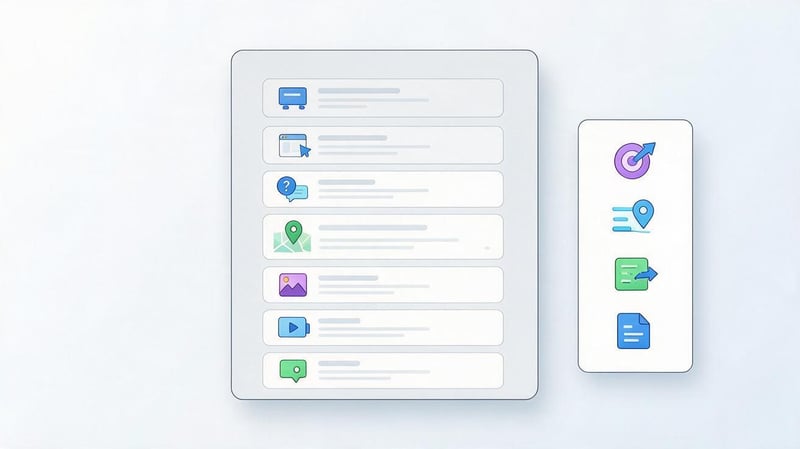
Before opening competitors' websites, carefully examine the SERP itself. It already shows document types, intent characteristics, the presence of ads, local results, images, and other blocks that influence organic CTR.
Search engines can devote a significant portion of the top screen to ads, maps, videos, and People Also Ask. However, the formal position of the URL doesn't always correspond to the amount of attention the result receives.
Therefore, the positions of competitors' sites should be considered in conjunction with the actual appearance of the search results page.
Search intent
Search intent answers the question of what action the user expects to perform after entering a query. They might search for information, compare options, choose a service, buy a product, or search for a specific website.
The easiest way to determine intent is to look at what types of pages occupy the majority of Google's top 10 search results. If they contain seven detailed articles and two reference pages, a typical commercial service page may be a poor match for the search query.
Sometimes the SERP is mixed. Then, articles, categories, and services appear in the results simultaneously. For such a cluster, it's important to understand what portion of the intent your own page fulfills and what type of competitors it should be compared to.
SERP features
SERP features occupy specific areas of search results and can significantly influence click distribution. These include Featured Snippets, People Also Ask, Local Packs, image blocks, videos, and other rich elements.
The presence of such a block suggests an additional content format. If Google regularly displays short answers to questions, it's worth providing clear definitions on the page. For local services, complete company information and accurate geo-referencing are important.
Microdata helps search engines understand data, but it doesn't guarantee rich results on its own. Page content and relevance to the search query remain mandatory.
Competitors' snippets
The snippet should be analyzed separately from the page text, as it's what the user first sees in search results. The title, description, display URL, breadcrumbs, and additional elements are recorded.
Then they look for recurring wording. For example, most leaders may have service type, geography, price, or instructions in their titles. This shows which characteristics are frequently used to convey the intent.
You can't copy meta tags. The goal is to understand the pattern and write your own Title and Description with a clear promise of the page's content.
How to analyze competitors' pages from the top 10?

After evaluating the SERPs, they move on to the URLs themselves. Here, they look for document structure, completeness of topic coverage, the presence of useful blocks, internal linking, and the page's relevance to the query.
It's best to conduct the analysis using a single spreadsheet. This way, one competitor won't receive more attention simply because their website is more visually appealing.
The same parameters are recorded for each page. Later, the table will show elements that recur systematically and solutions that are unique to one site.
Title, Description, and H1
First, compare the Title, Description, and H1 tags. Check the primary keyword, additional modifiers, length, geography, product mentions, and relevance to the page content.
If most strong results use a similar title tag, it should be considered a hint of intent. However, literal duplication of a competitor offers no advantage and runs the risk of producing a weak, indistinguishable snippet.
H1 is checked separately. It should clearly state the topic of the page and not conflict with the Title. Additional keywords are best distributed across H2–H4 and the main content.
Structure of H2–H4
Headings help you understand which subtopics competitors consider essential. For analysis, the H2, H3, and H4 headings of several strong pages are compiled and identical meanings are merged.
If seven out of ten articles explain competitor selection methods, and eight focus specifically on rankings and links, these topics are worth considering for your own page. A missing section on one competitor doesn't mean anything.
It's also useful to look for topics that are poorly covered by everyone. A good page can benefit from a clearer answer, example, or table, even if the topic itself is already listed.
Volume and completeness of content
Character count is a convenient guide, but it doesn't determine the quality of a page. Long, repetitive text can be inferior to short content that quickly answers a query and contains the necessary information.
During analysis, they look for definitions, step-by-step instructions, examples, tables, comparisons, checklists, FAQs, images, and tools. The order of blocks is also assessed: the user should quickly move from the question to the solution.
For your own page, the length is determined after comparing its structure. If all the relevant topics can be covered in 15,000 characters, there's no point in artificially stretching the article to 30,000.
Keywords and thematic semantics
The semantic core should be compared with the actual language of strong pages. In addition to precise queries, terms, entities, and set phrases are collected to help fully explore the topic.
For this article, these terms include SERP, search results, website visibility, ranking dynamics, search competitors, semantics, CTR, content gap, and other related concepts.
Keyword density shouldn't dictate the text. If an exact phrase must be repeated contrary to natural English, it's better to use a natural word form.
Internal linking
Internal links show connections between pages and help search engines find important sections faster. When analyzing competitors, the number of links, their direction, and the anchor text are recorded.
Links from pages that receive organic traffic themselves are especially interesting. If a strong competitor links informational content to commercial categories, this can suggest an approach to your own architecture.
There's no need to copy anchors exactly. Internal linking should reflect the structure of a specific website and the actual relationships between pages.
How to check technical factors of competitors' pages?
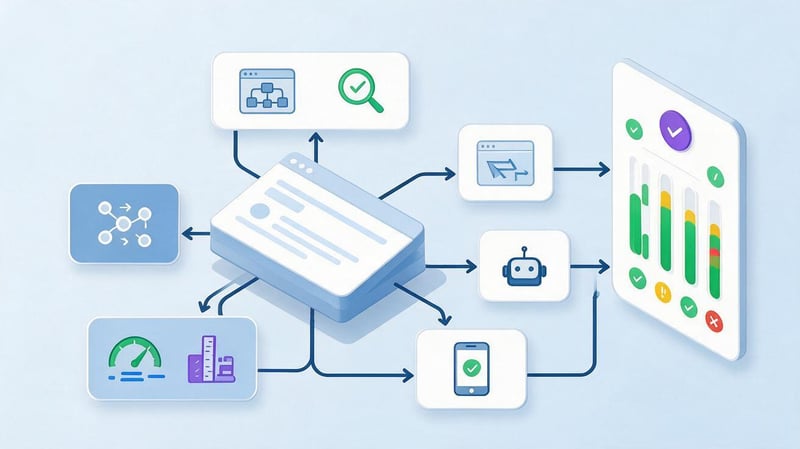
Technical analysis is necessary to avoid attributing all differences to content or links. Even a strong page can lose rankings due to issues with indexing, redirects, or the mobile version.
For competitors, only external technical data is available, so the conclusions will be limited. This is sufficient to compare URL status, canonical, load speed, microdata, and basic page elements.
The website itself is checked more deeply: through server logs, Google Search Console, a crawler, and content management system data.
Page indexing and accessibility
First, they check whether the URL is accessible to the search robot and what HTTP code it returns. For an indexed page, the normal response status is usually a 200 response without any unnecessary redirect chains.
Next, check the canonical, meta robots, and whether the page is in the sitemap. If the canonical points to a different URL, you need to determine whether this is an intentional setting or a technical error.
For our own project, we supplement the data by checking indexation in Google Search Console. For a competitor, we have to rely on available external signals.
Speed and mobile version
Page speed is assessed in conjunction with mobile usability. Core Web Vitals provide useful metrics, but they cannot be considered separately from the actual interface behavior.
They check how quickly the main content appears, whether banners and pop-ups obscure it, and whether the text and buttons are easy to read and interact with.
If the majority of niche leaders are significantly faster than your own website, technical optimization takes on additional priority. This is especially true when other page factors are comparable.
Structured data
Structured data is checked by a validator and compared with the visible page content. For an article, the following data types can be used: Article, BlogPosting, BreadcrumbList, and organization information.
FAQPage is only used where questions and answers are actually present on the page and the markup complies with current search engine requirements. Fake ratings and reviews are not allowed.
Product, LocalBusiness, and other Schema.org types are used only where they match the page's meaning. The more complex the JSON-LD, the more important it is to ensure that the data is consistent with the content.
How to analyze your competitors' link profiles?
A link profile helps evaluate the external support of a domain and individual URLs. Projects of the same type should be compared, as a large media outlet and a small corporate website can differ in links by several orders of magnitude.
First, they look at the entire domain, then the landing page and the topic section. This breakdown helps them understand whether a URL ranks thanks to its own backlinks or derives significant strength from its internal architecture.
Several metrics are used simultaneously for evaluation. A single authority metric from a third-party service does not replace the verification of real donors.
What indicators should be compared?
Basic metrics include backlinks, referring domains, link dynamics, and the number of external links directly to the URL of interest. Next, the topic and quality of donor sites are assessed.
It's useful to compare growth rates. If a competitor gets ten new domains a month, while your own site hasn't received any links for years, the gap will widen over time.
The distribution of links between the homepage, categories, services, and informational materials is examined separately. This helps understand which URLs the competitor prioritizes.
What types of links do competitors use?
Links are grouped by attributes, anchor text, topic, and placement method. This classification is more useful than simply counting the total number of backlinks.
After grouping, they look for consistent patterns. For example, strong competitors may regularly receive links from industry media, company directories, or expert publications.
Copying an entire profile is neither possible nor necessary. You need to find placement types that suit a specific site's theme, language, and region.
Dofollow and nofollow
Dofollow and nofollow should be considered as part of the overall picture. A healthy link profile rarely consists of only one type of link.
A high dofollow rate alone doesn't prove quality. Links from irrelevant, weak, or artificial sites may not produce the expected results and increase risks.
When comparing, it's best to open the donor sites themselves, check the placement pages, traffic, subject matter, and context of the link.
Anchor and non-anchor links
Anchors show the words other websites use to link to a page. A profile typically includes branded, commercial, partial, and non-anchored links.
Just because a competitor uses a lot of highly targeted commercial anchors doesn't mean you should replicate this scheme. Different domains have different ages, histories, and overall link volumes.
For your own project, the anchor list is compiled separately, based on the existing profile and planned landing pages.
Thematic donors
The donor's subject matter is assessed at the level of the entire website and the specific page where it is placed. For a bank, a financial media outlet is usually more relevant than a random entertainment portal, even if their formal authority metrics are similar.
They also check the language, region, actual search traffic, and content quality. The site should be indexed and appear like a live website, not a directory of publications for the sake of links.
It's more convenient to use a competitor's donor list as a source of ideas for outreach, rather than as a mandatory list of sites to copy.
How to roughly estimate the link budget?

First, they collect links from several comparable competitors and group them by placement type. Then, they check which platforms are available for publication and the typical cost of the appropriate format.
The resulting figure remains a guideline. It's impossible to accurately calculate the cost of reaching the top by multiplying the number of competitor links by the average placement price.
Some links may have been obtained for free, through PR, partnerships, or natural mentions. Therefore, it's better to use the link budget for planning purposes rather than as a promise of a specific position.
What tools should I use for SERP analysis?
For a few queries, some of the analysis can be performed manually. With a large semantic core, this approach quickly becomes inconvenient, so data on positions, history, and links is usually collected through specialized services.
You don't have to use one product for everything. Different services handle rankings, links, semantics, and history differently.
The main requirement is to maintain consistent data collection conditions. Comparing figures from different systems without understanding their methodology requires caution.
Manual Google analysis
Manual review is useful for assessing the actual SERP appearance. This clearly shows ads, Local Pack, videos, images, People Also Ask, and the types of pages that dominate the search query.
This method is suitable for a small number of phrases and quick search intent checks. It's too time-consuming for regular monitoring of hundreds of queries.
Manual verification is best used in conjunction with automated data. The service will display the numbers, and the open SERP will provide context for their proper interpretation.
Position checking tools
For monitoring, you can use SE Ranking, Serpstat, Ahrefs, Semrush, SpySERP, Rank Tracker, Plerdy, and other services. Their features vary, so the selection depends on the project's goals and budget.
SERP analysis requires position, history, competitors, region, device, and the ability to export results. An additional benefit is the ability to save search results by date.
It's more convenient to analyze competitors' website rankings in a single system and on a consistent schedule. This reduces discrepancies associated with different collection methods.
Link analysis tools
For backlinks, Ahrefs, Semrush, Serpstat, Majestic, or Moz are often used. It's advisable to check critical findings across multiple sources, as the link bases of each service vary.
Of interest are referring domains, anchor text, new and lost links, and specific donor pages. A single summary figure is insufficient.
Before buying links, review donors manually. Automatic metrics won't fully reflect the quality of the editorial content or the actual relevance of the placement.
Google Search Console
Google Search Console primarily applies to your own website. The performance report provides information on queries, clicks, impressions, CTR, and average position.
This data is convenient for comparing with competitors' SERPs. For example, a page may already be receiving a lot of impressions in positions 8–15, making it a good candidate for priority improvement.
GSC also helps you check indexing and detect URLs that Google chooses instead of the expected landing page.
How to turn a SERP analysis into an SEO work plan?

A large report is useless if it leaves the developer, SEO specialist, and copywriter unclear what to do. The final stage of analysis is translating observations into specific, prioritized tasks.
For each problem, you should indicate the current situation, competitor data, the proposed change, and how to test the results. Then, in a few weeks, you can return to the table and evaluate the impact.
It's better to divide tasks by pages and clusters. A general recommendation to “improve the website's SEO” doesn't provide the team with a clear next step.
Find the gap between your page and the top
First, compare the intent and document type. If Google shows categories, but your own site is trying to promote the article, further keyword calculations may not solve the underlying problem.
The structure, content, snippet, internal links, technical indicators, and link profile are then assessed. For each factor, a specific content gap or technical difference is identified.
The result is a table of hypotheses. Some of them can be tested quickly, while more costly changes are planned after obvious limitations have been corrected.
Divide tasks by priority
Priority depends on the impact of the issue and the cost of fixing it. An indexing error usually requires attention before adding another information block.
For practical work it is convenient to use three levels:
- critical tasks prevent a page from being indexed, passing the correct canonical, or matching the main intent;
- high-priority tasks are related to structure, important content gaps, internal linking and noticeable link gaps;
- medium priority is given to snippet improvements, additional examples, visual content, and other improvements that don't block promotion.
Once assigned, the team receives a clear sequence. First, constraints are eliminated, then factors are strengthened where the gap with competitors is supported by data.
Critical
Critical issues are those that prevent a search engine from processing a page correctly or cause it to treat a different URL as the target. These include erroneous noindex, incorrect canonical, redirect loops, and severe intent mismatches.
Such errors must be corrected before large-scale text or link expansion. Otherwise, budget is wasted on a page that is technically unprepared to compete.
After correction, a re-check is required through a browser, crawler, and available search engine tools.
High priority
High priority is given to tasks that can significantly impact the completeness and quality of a page. These include weak H2-H4 structure, missing required topics, poor internal linking, and a large gap in quality links.
This group also includes situations where competing pages respond to a query more quickly and clearly. In such cases, a content rework is required, rather than simply adding a few keywords.
It's best to link each task to a URL and a measurable result, such as increasing the number of queries in the TOP-10.
Medium priority
Medium priority is suitable for improvements that enhance an already correct page. These include additional tables, images, examples, expanded FAQs, or testing the Title and Description.
Such tasks shouldn't be ignored, but they come after more serious constraints have been addressed. With a limited budget, this helps prevent resources from being spread too thin.
Priority should be reevaluated after each major milestone. A page that moves up from position 30 to 11 requires a different set of actions.
Create a table of actions
The final plan should be short and clear. Detailed information can be kept on separate sheets, while the main task list stays the working one.
Example:
| Problem | Competitors | Us | What to change | Priority |
|---|---|---|---|---|
| Intent | The TOP is dominated by articles | Service page | Create informational material | High |
| Structure | Detailed H2–H3 and tables | Short text | Expand structure by intent | High |
| FAQ | Present on most leaders' pages | Absent | Add real questions | Medium |
| Links | 20–40 relevant domains | 5 domains | Create a link plan | High |
| Canonical | Self-canonical | Points to a different URL | Fix canonical | Critical |
This table links analysis with implementation. It makes it easy to distribute tasks among the developer, editor, SEO specialist, and link specialist.
Lead SEO specialist — Gennady
I don't select competitors for SERP analysis based on just one high-volume query. First, I assemble a cluster and look at which domains regularly appear in the top 10. Then, I separately compare the leaders, projects of comparable scale, and sites that have recently grown. Rank alone doesn't tell much: you need to look at the URL, dynamics, intent, content, and link profile of the page.
Common mistakes when analyzing competitors in SERPs

Errors in competitive analysis often appear even before analyzing the pages. Incorrect sampling leads the specialist to make detailed comparisons of websites that compete for different intent or operate under incomparable conditions.
The second group of errors relates to data interpretation. A correlation between a factor and a high ranking does not necessarily prove that this factor is what propelled the page to the top.
Below are the situations that most often reduce the practical value of the report.
Analysis of only one keyword
A single query provides too narrow a sample. Its SERP may be temporarily affected by tests, localization, algorithm updates, or the publication of a new document.
It's better to collect a group of queries from the same intent and look at the overlap between domains. This will reveal which competitors are systemically strong.
For a small cluster, a few dozen relevant phrases are sufficient. For a large section, the semantics can be significantly broader.
Comparison only with TOP-1
The first result is useful for research, but it shouldn't become the sole benchmark. A domain may have a strong brand, a huge backlink profile, and a long history, which a new project lacks.
It's much more informative to compare several pages from the top 10 and identify common patterns. Then, the leader's characteristics are examined separately.
This reduces the risk of copying an element that is not related to the reason for its high position.
Mixing different page types
An article can't be directly compared to a category just because they were matched by the same search query. These pages have different purposes, structures, and user journeys.
If the SERP is mixed, pages are first categorized by type. Then, your own URL is compared with documents that address similar intent.
This is especially important when analyzing commercial and informational queries with similar wording.
Ignoring region and device
Search results can vary significantly across cities and devices. Even within a single country, the same company can rank differently in local niches.
Before comparing, record the region, language, and device type. For mobile traffic, it's advisable to check the mobile search results separately.
Without these parameters, a re-measurement may show a change that is related to the test settings, rather than to the actual growth of the site.
Copying a competitor instead of looking for patterns
Copying the structure, meta tags, and paragraphs of the leader rarely yields useful results. Each domain has its own history, architecture, links, and trust level.
You should look for patterns between several strong pages. If a similar theme, format, or element appears on most of the top performers, it's worth testing it on your own site.
After this, the solution is adapted to the specific product and audience. The user should receive standalone content, not a retelling of the page next to it.
Ignoring dynamics
A single search results slice shows the status as of a specific date. It doesn't indicate how long sites have held their positions or how stable this ranking is.
Ranking history helps distinguish stable leaders from temporary gains. It also shows the moment of decline or growth, which can be correlated with changes in the site.
Re-analysis is especially necessary after major updates, migrations, and significant edits to landing pages.
SERP competitor analysis checklist

The checklist is useful before preparing recommendations. It helps you remember basic information and avoid moving on to links before checking intent or indexing.
For large projects, it's best to maintain a separate checklist for each cluster. This way, the same issue doesn't automatically spread to all pages of the site.
| What to check | Result |
|---|---|
| Query cluster | Collected and cleaned |
| Region and language | Recorded |
| Device | Desktop and mobile tested |
| TOP 10/20 | Saved |
| Main search competitors | Determined |
| Positions of competitors' websites | Compared |
| Position dynamics | Verified |
| Search intent | Determined |
| SERP features | Recorded |
| Title, Description, H1 | Compared |
| Structure of H2–H4 | Collected |
| Content | Analyzed |
| Internal linking | Verified |
| Technical parameters | Verified |
| Link profile | Compared |
| Growth points | Written down |
| Task priority | Assigned |
Once the table is filled, a specific action list should appear. If the checklist is complete and the team still doesn't understand which URL to change and how, the analysis needs to be refined.
SERP analysis should begin with a cluster of queries and actual search results. Then, systemic competitors are selected, their rankings are checked over time, and intent, pages, technical factors, and links are consistently compared.
The main value of the analysis emerges during the implementation phase. Each identified gap requires a specific URL, task, priority, and method for re-verifying the results.
If your site is losing rankings or you're preparing a new section, start with a SERP audit of the target cluster. Collect the top results, compare competitors' pages, and turn the data into an SEO plan before changing content or building links.


