What is the semantic core of a website?


Imagine an online store that sells bicycles. The catalog includes mountain bikes, city bikes, and children's bikes, the product specifications are well-documented, and the pages load without errors. However, Google traffic is low. One possible reason is that the store's structure doesn't take into account the queries customers use to search for bicycles.
Some users search for “buy a mountain bike”, others for “bike for a 7-year-old”, and still others compare models based on their specifications. Each search term represents a specific need that a website must address when creating its pages.
To understand the keywords used by potential customers, SEO specialists compile a semantic core. This helps identify popular topics, plan the website structure, prepare content, and distribute search queries across pages.
Let's explore how website semantics work, which tools are suitable for collecting them, and how to turn the resulting list of keywords into a working SEO plan.
What is the semantic core of a website?
The semantic core of a website is a structured set of search queries that correspond to the website's theme, its products, services, and the needs of the target audience. Queries are grouped into semantic groups, their frequency and search intent are analyzed, and then distributed among existing or future pages.
For example, for an online bicycle store, search queries like “buy a bicycle”, “mountain bike price”, or “children's bike with 20-inch wheels” might be appropriate. For the same store's blog, other phrases might be more useful: “how to choose a frame size” or “what's the difference between a mountain bike and a city bike”.
In SEO, this distribution helps create pages tailored to specific user needs. A single URL can cover dozens of related queries if they require the same answer or page type.
How does a semantic core differ from a regular list of keywords?
A typical keyword set can contain thousands of phrases collected from various services without any additional processing. Such a list often contains duplicates, irrelevant queries, and phrases that reflect different user intents.
Let's say we received the following queries while selecting keywords for a bicycle shop website:
| Keyword | Suitable page |
|---|---|
| buy a bicycle | Bicycle category |
| bicycle prices | Bicycle category |
| mountain bikes | Mountain bike subcategory |
| buy a mountain bike | Mountain bike subcategory |
| How to choose a bicycle | Informational article |
| Which bike is best for the city? | An article about choosing a city bike |
After grouping, it becomes clear which queries can be promoted together and where separate content is needed. This helps avoid creating multiple, nearly identical pages competing with each other in search results.
Answers to your questions
How many keywords should be in the semantic core?
The number of keywords depends on the site's size, the number of products and services, the competitive environment, and the depth of search demand research. A small service website may work with several hundred relevant queries, while the semantic core of a large online store can contain tens of thousands of phrases.
However, there is no universal standard that every project must meet. Much more important are comprehensive coverage of relevant queries, proper clustering, and the connection of semantics to the site structure.
If a table contains many irrelevant or duplicate phrases, increasing its size will not yield practical benefits. Therefore, the core size is assessed in conjunction with the quality of the collected data.
Is it possible to build a semantic core for free?
Yes, for a small project, you can build basic semantics without purchasing a professional SEO service. Google Search Console, Google Trends, search suggestions, and the available features of Google Keyword Planner are all suitable.
However, the free approach requires more time to manually collect, process, and validate queries. When working with large catalogs, automation can significantly reduce the amount of repetitive work.
Before choosing a paid program, it's a good idea to determine which steps actually take the most time. Sometimes, for a small website, a simple spreadsheet and a few available data sources are sufficient.
How often should the website's semantic core be updated?
There is no standard update schedule, as the needs of different projects vary significantly. Semantics are revised when product offerings expand, services change, new areas emerge, and search demand fluctuates significantly.
It's also worth regularly analyzing the queries that your site ranks for in Google Search Console. This helps you discover additional topics and track changing audience interests.
For large projects, it's useful to schedule regular audits for specific areas. The frequency of updates is determined based on the number of changes on the website and the SEO team's resources.
Where to insert the semantic core on the website?
The semantic core is typically stored in a spreadsheet and does not require a separate file on the website. The collected queries are used to develop the structure, optimize meta tags, and prepare landing page content.
For example, the main cluster might define the category topic, its H1 and Title, while additional queries help uncover product characteristics and customer questions. For informational pages, semantics are used to structure the text.
There's no need to insert the entire keyword list into a single text or technical field. Queries should be distributed across relevant pages, taking into account search intent and the actual content of the site.
Is it possible to use a ready-made semantic core?
A completed semantic core can be used as a source of additional ideas and a basis for preliminary research. However, it must be verified for relevance to the specific business, region, language, and current search demand.
For example, a table for an online sporting goods store might contain queries for product ranges that another company doesn't offer. It might also contain outdated product names and irrelevant commercial areas.
Before using ready-made semantics, it's important to check the search volume, intent, cluster composition, and target pages. Only after this analysis can the data be included in the working SEO plan.
What is the difference between a semantic core for SEO and Google Ads?
An SEO core is used to plan a website's structure, optimize pages, and attract organic search traffic. It takes into account search intent, page content, competition, and the long-term value of queries.
In Google Ads, keywords are used to set up advertising campaigns and display ads. Match types, negative keywords, ad groups, bids, and conversion metrics are also important.
Some queries may be common to both channels, but the resulting tables usually differ. Therefore, it is recommended to prepare SEO semantics and the advertising core taking into account the objectives of each channel.
Is it possible to find out the semantic core of a competitor’s website?
Obtaining a complete working table of another website's semantic core without access to its internal data is usually impossible. However, SEO services allow you to evaluate the queries for which the site appears in search results.
Serpstat, Ahrefs, Semrush, and other competitive domain research tools are used for analysis. Additionally, the site structure, categories, meta tags, and landing page content are examined.
This data is useful for discovering new topics and comparing your own reach with competitors. However, third-party service metrics remain estimates and may differ from the site's actual analytics.
Is it possible to create a semantic core using artificial intelligence?
AI can be used to prepare marker queries, generate additional wording, and pre-group thematic areas. It also helps analyze large lists of keywords and identify semantic intersections.
However, generated queries do not confirm the existence of real search demand. To check search volume, competition, and search results composition, data from relevant SEO tools is required.
Automatic grouping also requires human oversight, as seemingly similar phrases may have different intentions. Therefore, it's wise to use AI at the preparatory stages, while maintaining manual verification of the results.
What does the semantic core consist of?

The basis of the semantic core is formed by keywords and search phrases that users enter into Google. However, for practical work, a specialist needs additional information about each query: demand, search intent, topic group, and the page that should answer it.
The following data is usually recorded in the worksheet:
- Search query – the wording that the user enters into the search bar.
- Query frequency – assessment of search demand for a certain period, taking into account the region and data source.
- Search intent – the task that a person expects to solve after visiting the site.
- Cluster – a group of related queries for which one landing page is suitable.
- Target URL – the address of an existing or planned page corresponding to the cluster.
- Priority – assessment of the importance of a group of queries for business and further promotion.
Once the table is created, it becomes clear which pages are already meeting demand and which sections still need to be developed. This data is used when developing the website structure, preparing SEO specifications, and planning optimization.
Why do you need a semantic core for a website?
A semantic core is used when developing a new website, expanding an existing catalog, and planning SEO. It reveals what topics interest potential customers and which pages need to be developed to meet this demand.
Without prior research, a structure is often created based on a company's internal classification system. This approach can miss product names familiar to customers, popular features, and specific commercial queries.
Forming the correct website structure
When developing a structure, the company's product range is first studied and then compared with search demand. For example, a store might group all bicycles into one category, even though users search separately for mountain bikes, city bikes, children's bikes, and folding bikes.
If each group has its own distinct search demand and sufficient product range, it can be dedicated to a separate page. This should take into account the overlap of search results to ensure that new sections don't duplicate existing ones.
The semantic core helps map future URLs and define relationships between pages. This structure facilitates catalog navigation and helps search engines find relevant sections of the site.
Attracting targeted organic traffic

A high search volume doesn't guarantee that clicks on it will be beneficial to a business. For example, someone searching for “bicycle pictures” may not be planning a purchase at all, whereas a search for “buy a mountain bike in Kyiv” indicates a much more specific need.
When selecting queries, the specialist evaluates their commercial potential, region, competition, and product line relevance. This directs resources to pages likely to attract an interested audience.
After implementing optimization, changes are tracked using Google Search Console and web analytics systems. The dynamics of impressions, clicks, organic traffic, and visitor conversions are assessed.
Content and internal linking planning
Search queries help identify topics for future articles and topics to cover on commercial pages. For example, articles on frame size selection, brake types, and drivetrain maintenance might appear next to the mountain bike category.
Informational articles are linked to relevant categories and other blog content. This creates internal linking, helping visitors navigate between related topics and find the products they need.
When creating a content plan, it's advisable to consider existing publications to ensure new articles don't duplicate their content. For each piece, determine in advance the main cluster, intent, and intended role within the site's structure.
Finding new business opportunities
Search demand sometimes reveals needs that a company hasn't yet addressed in its product range. For example, regular searches for a certain size of children's bicycles can prompt a company to check the availability of such models and evaluate the potential for expanding its catalog.
To make more accurate decisions, demand data is compared with sales, margins, product availability, and customer behavior. High demand alone does not necessarily mean a new direction will be profitable.
Semantics also helps identify seasonal categories, regional specifics, and additional services that appeal to audiences. These insights can be used when planning advertising campaigns and further website development.
What types of search queries are there in the semantic core?

When compiling a semantic core, it's important to understand why a user enters a specific phrase and what results they expect. Two queries with similar words may relate to different stages of the product selection process and require different types of pages.
Search intent, search volume, geography, seasonality, and query specificity are typically considered for classification. These characteristics help to correctly combine keywords and select the appropriate landing page.
Classification by search intent
Search intent indicates what task a user wants to accomplish through a search. They might be researching information, comparing offers, searching for a specific website, or ready to place an order.
For SEO, it's especially helpful to compare the intended intent with actual Google results. If online store categories mostly rank for a query, an informational article may not be the best format for promoting it.
Informational queries
Informational queries are used when seeking an explanation, instructions, comparisons, or an answer to a question. Examples of such queries include: “how to choose a bicycle”, “what is the difference between a carbon frame and an aluminum frame”, and “what tire pressure should I use?”
Typically, such queries are suitable for articles, instructions, help sections, and guides. After reading the material, some users may proceed to purchasing a product or service.
High-quality informational content should answer the initial question and help clarify the details. Specific examples, comparison tables, photographs, and explanations of terms are all suitable for this purpose.
Commercial and transactional queries
Commercial queries often involve choosing an offer, researching terms, and comparing options. A user might search for “best mountain bikes”, “bicycle prices Kyiv”, or “compare Trek and Giant bikes”.
Transactional language often indicates a willingness to take action: purchase a product, place an order, or sign up for a service. An example of such a query is “buy a 29-inch mountain bike”.
Categories, product cards, and service pages with clear terms and conditions are suitable for such queries. These pages should provide information on product specifications, price, availability, delivery options, and the ability to place an order.
Navigational and brand queries
A navigational query occurs when a user wants to open a specific website, service, or company page. For example, a person might type a store name along with the words “catalog”, “contacts”, or “user account”.
Branded queries contain the name of a company, trademark, or specific product. They can have informational, commercial, or navigational intent depending on how they are worded.
These keywords are considered separately when analyzing organic traffic and search visibility. An increase in brand demand doesn't always reflect an improvement in rankings for general commercial queries, so it's useful to track these areas separately.
Classification by frequency

Search volume shows how often users search for a specific phrase over a given period. This estimate is based on data from SEO services and search demand research tools.
There are no uniform numerical boundaries between high-frequency, mid-frequency, and low-frequency queries. A query with several hundred searches may be considered significant for a narrow B2B niche, but insignificant for a mass-market online store.
High-frequency queries
High-frequency queries cover a broad topic and typically have relatively high search volume. Examples include “bicycles”, “laptops”, or “apartment renovation”, although the exact search volume category varies by region and topic.
These phrases are often highly competitive and have ambiguous search intent. Users may be searching for a product, images, reference information, or a comparison of offers.
To optimize for broad queries, it's necessary to evaluate the types of pages in search results and the actual value of the expected traffic. Sometimes, several more specific clusters prove more beneficial for a business than a single popular query.
Mid-frequency queries
Mid-frequency queries are typically more specific than broad topical phrases and help highlight a specific group of products or services. For example, the query “buy a city bike” contains a clearer commercial intent than the single word “bicycle”.
Such phrases are often used when optimizing categories, subcategories, and individual commercial pages. However, they should be evaluated alongside actual search results and business characteristics.
Having suitable products, competitive terms, and a fully functional landing page can be more important than simply dividing search queries by frequency. Therefore, several prioritization criteria are used when planning work.
Low-frequency and long queries
Low-frequency queries often describe a specific product, feature, problem, or purchase requirement. For example, “buy a 20-inch children's bicycle with an aluminum frame” contains several specific keywords.
Such phrases often fall under the long tail of search queries. Each individual phrase may be rare, but collectively, such queries can attract a significant audience.
There's no point in removing them simply because of low search volume. In certain niches, specific queries better reflect a person's willingness to contact a company or purchase a product.
How do region, language, and seasonality affect the semantic core?
Users from different regions may use different wording and expect different search results. For example, for a service with a physical address, the queries “bicycle repair Kyiv” and “bicycle repair Dnipro” address different geographic needs.
When selecting keywords, it's important to consider the countries and cities in which the company actually operates. High demand in another region alone doesn't make a keyword suitable for a specific business.
Multilingual websites require special attention. Russian, Ukrainian, and English queries should be researched separately, as common product names and wording frequencies may vary.
Seasonality also influences priorities. For example, interest in bicycles can fluctuate throughout the year, so Google Trends data can be useful for comparing with sales and search traffic trends.
How to create a website's semantic core yourself?

Semantic core compilation begins with business research and ends with query distribution across pages. Between these stages, it's necessary to expand the list of keywords, clean the data, determine search intent, and create thematic groups.
Let's look at the process using the example of an online bicycle store operating in Ukraine and having both Russian and Ukrainian versions of the website. A separate list of queries will be prepared for each language version, taking into account the corresponding search demand.
Step 1. Research your business and target audience
Before collecting keywords, it's important to understand the product range, operating conditions, and characteristics of potential buyers. For a bicycle store, it's important to know the types of models, available sizes, brands, price ranges, and delivery regions.
Additionally, it's worth studying customer inquiries, questions to managers, and the characteristics of the most popular products. This information helps identify familiar wording, which doesn't always correspond to internal category names.
After studying the business, a preliminary list of product categories is compiled: bicycles, spare parts, accessories, maintenance, and additional services. At this stage, there's no need to exhaust all possible search terms, as detailed expansion will be done later.
Step 2. Collect base (marker) keywords
Marker queries are the main keywords and short phrases that describe the website's products, services, and thematic areas. For a bicycle store, initial markers might include “bicycle”, “mountain bike”, “children's bike”, “bike helmet”, and “bicycle tires”.
Based on these markers, additional queries are then found with characteristics, brands, sizes, and commercial specifications. For example, the marker “children's bicycle” can be expanded with wording related to the child's age, wheel size, and frame material.
It's convenient to create a basic set of keywords in Google Sheets or Excel. It's a good idea to specify the category, language, and region right away to avoid mixing up different areas as you expand.
Step 3. Analyze your competitors' search semantics
For analysis, select websites that are already present in Google for key thematic and commercial queries. It's also worth exploring the business's direct competitors and websites competing for search traffic for the relevant topics.
First, they examine the catalog structure, category names, filters, information sections, and landing page content. Then, using SEO services, they can evaluate the queries that competitors' sites use to rank in search results.
Of particular interest are semantic gaps—relevant topics that competitors are covering but the site being researched is currently missing. It's also useful to study the overlap of keywords across multiple competitors to identify recurring, popular topics.
There's no need to copy someone else's structure entirely. Each identified group is checked for consistency with the product range, search intent, and goals of your own business.
Step 4. Expand your list of search queries

After preparing the marker list, the semantic core begins to be expanded. The main goal of this stage is to find real-world phrases that users use to describe products, services, features, and problems they encounter.
You can combine Google Keyword Planner, Search Console data, search suggestions, and professional SEO services. These sources overlap but may contain additional query variations.
Using Google Keyword Planner
Google Keyword Planner is located in the Google Ads interface and helps you research keywords related to products and services. The tool offers query suggestions, displays average monthly demand estimates, and allows you to work with selected regions and languages.
To expand your semantics, open the tool, select the new keyword search, and enter your marker phrases. For example, you could start with the queries “mountain bike” and “children's bike”, then explore the suggested options.
The results must be verified for product range compliance, and then the relevant data must be exported for further processing. Access to certain Google Ads features may require complete account setup, including payment information.
Keyword Planner's competition metrics are part of the advertising system and cannot be used directly as an estimate of organic SEO difficulty.
Using Google Search Console
Google Search Console is especially useful when working with an existing website that receives impressions on Google. In the search performance section, you can examine queries, impressions, clicks, CTR, and average position.
To collect semantic data, it's worth choosing a sufficiently long period and exporting the data from the report. The queries are then compared with existing pages to identify topics that the site already partially covers.
For example, the mountain bike category may show up for queries about a specific wheel size, even though this feature is underrepresented on the page. This signal helps identify areas for further optimization.
It's important to note that Search Console doesn't reveal all search queries. Some data is hidden or limited by reporting features, so it's best to use the service in conjunction with other sources.
Collecting search suggestions and related queries
Google search suggestions help find additional phrases that users associate with the original topic. For example, typing “how to choose a bike” might reveal additional details related to a person's height, a child's age, or the conditions of use.
It's also helpful to study related search queries and questions that Google displays on the results page. These help identify characteristics that interest the audience and topics for future content.
However, the presence of a phrase in the suggestions does not confirm its specific search volume or commercial value. Before including a query in the core, its relevance and appropriate search intent must be verified.
Automatic keyword parsing
Keyword parsing is used to collect queries in bulk from selected sources. A specialized program or online service processes the initial phrases, extracts additional keyword variations, and generates an export for further analysis.
Automatic semantic collection speeds up work with large catalogs that require processing multiple categories and product characteristics. Some services also help collect search frequency, remove duplicates, and perform preliminary grouping.
However, the parsing results require verification. Automatic exports often contain outdated product names, queries for inappropriate regions, random phrases, and phrases with different search intent.
When choosing a tool, consider available data sources, terms of use, and service limitations. For large projects, it's advisable to provide the ability to re-export and save the original data.
Step 5. Clean up the semantic core

After collecting keywords from multiple sources, the list often contains duplicate, irrelevant, and overly general queries. If you immediately begin clustering, the extraneous wording will complicate grouping and may lead to the creation of unnecessary pages.
Therefore, semantic cleansing is performed first, checking the relevance of each keyword to the company's activities. However, it's not advisable to rely solely on search volume or automatically remove all ambiguous queries.
Removing duplicates and irrelevant phrases
The first stage of cleansing is to find complete duplicates that appeared when merging the exports. This is done using spreadsheet functions or specialized tools that take into account case and other phrase notations.
Then they check semantic relevance. For example, a new bike store might not be interested in queries about buying used bikes if the company doesn't sell such items.
Some queries must be manually researched, as a single word can have multiple meanings. The final decision is made based on context, search results, and actual business opportunities.
Working with stop words
Stop words are used during the cleaning process to identify groups of queries that are not related to the company's offerings. For example, if a store only sells new bicycles, search terms containing the words “used” or “pre-owned” could be considered candidates for exclusion.
However, automatically removing all phrases containing a certain word sometimes results in the loss of useful semantics. For example, the word “free” may appear in queries about free shipping, which the store actually offers.
To analyze large lists, lemmatization is used to find different forms of a single word. It's advisable to validate the final solutions with examples, especially when queries have ambiguous meanings.
Checking frequency and seasonality
After cleaning, you need to determine search demand for the remaining queries. To do this, use search volume estimates with identical region and period settings so that the data can be compared.
Low-volume queries don't necessarily need to be excluded. Sometimes they reflect specific customer needs and can be useful for optimizing existing pages.
Seasonality must also be taken into account. For example, demand for certain categories of bicycles can vary significantly in spring and winter, so comparing just one month can skew priorities.
Step 6. Group queries by meaning and search results

Clustering is the process of combining search queries into groups that can be promoted on a single page. Grouping takes into account the topic, user intent, and similarity of search results.
For example, the queries “buy a mountain bike” and “mountain bike price” may belong to the same commercial category. However, the phrase “how to choose a mountain bike” would typically require a separate informational piece.
Clustering by meaning
Semantic clustering analyzes the meanings of queries and the needs they express. Similar words are not always grouped together because they may suggest different user actions.
For example, “bicycle repair” might mean searching for a repair shop, while “how to repair a bicycle” might mean searching for a DIY manual. These queries might require different pages.
Semantic clustering can be conveniently performed manually for a small core, or specialized services can be used for pre-processing large lists. After automatic clustering, edge cases should be checked.
Google URL Intersection Clustering
SERP clustering takes into account search results for multiple queries. If Google shows a significant number of identical pages, this may indicate similar search intent.
Different algorithms and grouping settings are used depending on the service. The Soft, Moderate, and Hard approaches have different requirements for result overlap, but the specific implementation depends on the tool used.
Too lenient grouping can lump together queries that require different landing pages. Too strict grouping can sometimes create numerous small clusters, so the final results need to be verified against actual search results.
Step 7. Distribute clusters across pages
After grouping, each cluster is assigned a target page. If a suitable URL already exists, it is noted in the table and the need for further optimization is assessed.
When a separate page doesn't exist, a specialist checks the feasibility of creating one. For example, a new subcategory is justified if there's independent search demand, sufficient product offerings, and noticeable differences from the parent category.
At this stage, a relevance map is created, linking groups of queries to page addresses. This helps avoid situations where multiple URLs simultaneously claim the same search intent.
Lead SEO specialist — Gennady
In my work, I often encounter websites whose owners have already collected several thousand keywords but still don't understand which pages need to be optimized. The problem usually stems from a lack of clustering and distribution of queries across URLs.
I always start by checking search intent. For example, the query “buy a bicycle” would logically lead to a product category, while “how to choose a bicycle” would lead to detailed instructions. If you combine these topics without considering the search results, the page could be inconvenient for both groups of users.
Therefore, I evaluate the quality of the semantic core based on how accurately the queries are related to the site structure, product range, and audience needs.
Step 8. Prioritize and prepare a summary table
After cluster assignment, the implementation sequence must be determined. This is done by assessing search demand, commercial value, the competitive environment, the availability of a suitable page, and the scope of the required changes.
For example, optimizing an existing category with a good selection may require fewer resources than creating a large new section. However, the potential impact depends on page visibility, demand, and the site's technical condition.
It's a good idea to supplement the final table with responsible parties, completion statuses, and review dates. This format helps integrate the semantic core into ongoing SEO work and ensure timely data updates.
What tools should be used to collect a semantic core?

To select keywords, you can use free Google tools, professional SEO platforms, and bulk query processing software. The choice depends on the site's size, budget, and the depth of research.
A small service website often requires only manual analysis and a few data sources. An online store with thousands of products typically requires automated collection, frequency checking, and clustering.
Free and freemium tools
For initial semantic data collection, tools that help research search demand and analyze existing traffic are suitable. Each of these tools addresses a specific task and has its own limitations.
| Tool | What to use for |
|---|---|
| Google Search Console | Analysis of queries, impressions, clicks, and pages of your own website |
| Google Keyword Planner | Selecting new keywords and assessing search demand |
| Google Trends | Studying the seasonality and relative popularity of queries |
| Google Search | Search suggestions, related queries, and search results analysis |
| Google Sheets | Cleaning, sorting and grouping the collected data |
| Excel | Processing exports and working with large tables |
Google Keyword Planner's free features depend on your ad account settings and status. The tool's data should be viewed as demand estimates, not as an exact number of future visitors.
Google Trends displays the relative popularity of queries on a scale from 0 to 100. These values should not be taken as an absolute number of searches.
Professional SEO services
Professional platforms help analyze competitors, expand your keyword base, and evaluate search visibility. For example, Serpstat, Ahrefs, and Semrush offer tools for researching queries and competitor sites.
Such services are especially useful when you need to compile a large semantic core or compare several large projects. They allow you to quickly find related queries and identify topics already covered by competitors.
However, search volume and ranking difficulty metrics may vary across platforms. Therefore, it's advisable to document the source of the data and avoid combining disparate indicators without further verification.
For automatic clustering, specialized programs that analyze the intersection of search results can be used. However, the grouping algorithms and input data requirements must be studied separately.
Is it possible to create a semantic core automatically and online?
An automatic semantic core generator can speed up phrase collection, additional keyword suggestions, and preliminary grouping. Some services also offer duplicate removal, frequency detection, and export of ready-made tables.
However, automatic assembly doesn't take into account all the specifics of a specific business. The program may add queries for products not in the range, unsuitable regions, or services the company doesn't provide.
The final results must be verified based on product range, search intent, and site structure. Commercial clusters should be examined particularly carefully, as errors at this stage can lead to the creation of irrelevant landing pages.
Is it possible to build a semantic core for free?
Free semantic core collection is possible, especially if your website is small and has a limited number of services or product categories. To get started, you can use Google Search Console, search suggestions, Google Trends, and the available Keyword Planner features.
The main costs in this case are related to the specialist's time. Manually processing queries, checking search results, and distributing them across pages require attention, even if paid services are not used.
For large projects, the free suite may not be sufficient due to the volume of data. When choosing a paid program, it's worth considering how much time it saves and which work steps it truly automates.
For projects targeting other search markets, Bukvarix and Yandex Wordstat are sometimes considered. However, for promotion in Google Ukraine, the primary focus should be on data from the relevant region and search engine.
What does a finished website semantic core look like?
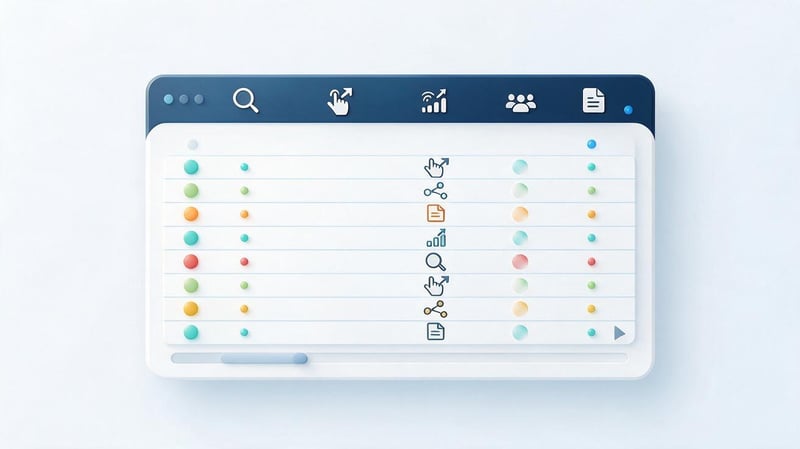
The completed semantic core is usually formatted as a table, where each query is associated with a thematic group and a target page. This file is used by SEO specialists, editors, developers, and other project participants.
A convenient table structure should help quickly find the necessary data and track completed work. For large sites, individual areas can be divided into sheets, while maintaining a common notation.
Example of a semantic core table
Let's consider a simplified example for an online bicycle store. In a real project, the list of queries will be significantly broader, and clusters may contain dozens or hundreds of related phrases.
| Search query | Intent | Frequency | Cluster | Target URL |
|---|---|---|---|---|
| buy a bicycle | Commercial | Check | Bicycles | /ru/velosipedy/ |
| bicycle prices | Commercial | Check | Bicycles | /ru/velosipedy/ |
| mountain bikes | Commercial | Check | Mountain bikes | /ru/velosipedy/gornye/ |
| children's bicycles | Commercial | Check | Children's bicycles | /ru/velosipedy/detskie/ |
| How to choose a bicycle | Informational | Check | Choosing a bicycle | /ru/blog/kak-vybrat-velosiped/ |
| bicycle frame size | Informational | Check | Frame size | /ru/blog/razmer-ramy-velosipeda/ |
The addresses provided are used solely for illustrative purposes. Actual frequency data should be obtained from the selected tool with the correct region and language settings.
You can add columns to the actual table for competition, business priority, page status, and last update date. This format facilitates further work with semantics and optimization monitoring.
How to format a large semantic core in Excel or Google Sheets?
When working with a large number of queries, it's best to split the data into processing stages. This helps preserve the original exports and restore information if certain phrases were deleted by mistake.
The practical structure of the file may include several sheets:
- Initial data – all search queries obtained from the tools, indicating the source and date of export.
- Cleaned semantics – verified keywords after removing duplicates and irrelevant phrases.
- Clusters – thematic groups of queries, combined taking into account search intent.
- URL map – distribution of clusters between existing and planned pages.
- Implementation plan – priorities, responsibilities, necessary tasks and current statuses.
This arrangement is convenient for collaboration between specialists, as it allows for the separation of demand research from optimization implementation. When updating a file, it's advisable to preserve the change history and avoid deleting the original data unnecessarily.
For large tables, filters by language, region, page type, and business area are also useful. They help quickly find relevant queries and create separate tasks for different sections of the site.
What to do with the semantic core after collection?

Once the data collection is complete, the practical application of the obtained data begins. The semantic core is used to modify the website structure, optimize existing pages, develop new materials, and configure internal linking.
The keywords themselves don't need to be uploaded to the site as a separate file or pasted into a special field. The research results are applied to specific page elements based on search intent and the content of each section.
Create or optimize landing pages
For each cluster, it's necessary to identify the page that should respond to the corresponding queries. If a suitable URL already exists, its content, structure, and current search visibility are analyzed first.
When optimizing, consider the Title, Description, H1, subheadings, main text blocks, and internal links. Keyword phrases should appear naturally and be relevant to the page content.
If there's no suitable page, a decision is made to create a new section. For example, a separate category might be needed for a popular product group that's currently only available within the general catalog.
New URLs should be created with navigation logic in mind and to prevent duplicates. For commercial pages, they should also check for product information, pricing, delivery, and purchase terms.
Prepare SEO specifications for texts
The semantic core helps formulate assignments for copywriters and editors. The selected cluster is used to determine the topic of the material, search intent, key user questions, and the structure of the future page.
A high-quality SEO specification should include the title, description, H1, recommended text sections, and related terms. Additionally, you can describe requirements for examples, tables, images, and internal linking.
However, an excessive number of exact matches can impair the readability of the material. Therefore, it's better to organize queries by meaning, using natural word forms and avoiding repetition of identical wording in adjacent paragraphs.
Set up internal linking
After distributing queries across pages, you can identify thematic links between website sections. For example, an article about choosing a children's bicycle might contain a link to a related product category.
Links to related instructions, comparisons, and help pages are helpful for informational materials. This approach helps visitors continue their exploration of the topic and navigate to the relevant sections without further searching.
When setting up interlinking, it's important to use clear anchor text and select truly related pages. An excessive number of similar links with commercial keywords detracts from the text's readability and rarely provides any benefit to the user.
Check positions, impressions, clicks, and conversions
After implementing SEO changes, it's important to track the results for selected pages and query groups. For this, use Google Search Console, web analytics systems, and position monitoring tools.
In Search Console, you can study impressions, clicks, CTR, and average positions for specific URLs and queries. When analyzing, it's recommended to compare similar periods, taking into account seasonality and changes in demand.
Additionally, inquiries, purchases, and other targeted actions are evaluated. Increased organic traffic is beneficial for a business when a website attracts the right audience and helps them complete the desired action.
How does the semantic core differ for different types of websites?

The principles of semantic data collection remain similar, but the structure of queries depends on the website's purpose. An online store requires a detailed product classification, while a blog prioritizes coverage of thematic issues and information needs.
For a service website, commercial language, regional relevance, and specific company offerings are paramount. Therefore, a universal keyword table cannot be equally suitable for all projects.
Semantic core of an online store
Online store semantics typically encompass categories, subcategories, product pages, brands, and individual product characteristics. For example, queries might relate to bicycle type, wheel size, frame material, or a specific model.
When creating a structure, it's important to consider the product range and actual search results. Not every filter should be turned into a standalone indexed page, even if a combination of characteristics appears in queries.
Separate pages are created for groups with sufficient demand and independent value for buyers. It's important to monitor duplicate content, URL parameters, and internal linking within the catalog.
Semantic core for a blog and information website
For an information project, the core semantics are questions, instructions, comparisons, and thematic queries. When collecting information, it's important to determine what aspects of the topic users want to explore and what materials already exist on the site.
For example, a bicycle blog might include separate articles on choosing a model, chain maintenance, brake adjustment, and preparing for rides. However, it's best to combine queries with similar intent into full-fledged articles.
For a large informational website, it's helpful to create thematic groups of publications with logical internal linking. This facilitates navigation and helps readers consistently explore the topic of interest.
Semantic core for landing pages and service websites
A landing page typically focuses on a single offer or a small group of closely related services. Therefore, when selecting keywords, it's important to focus on queries with similar commercial intent.
If a company provides several independent services, they may require separate landing pages. For example, queries about online store development and corporate website creation often involve different needs and commercial offers.
For local services, regional wording, demand patterns, and the availability of physical service points are additionally considered. Geographical pages should also contain useful information about the company's operations in the relevant city.
Semantic core for contextual advertising
In contextual advertising, keywords are used to customize ad impressions for selected search queries. When working with Google Ads, match types, negative keywords, ad groups, and landing pages are taken into account.
Contextual advertising semantics are often focused on specific user actions and the commercial value of search queries. Budget, acquisition cost, and conversion results are also important for the advertising core.
Some queries can be used simultaneously in SEO and advertising, but the methods for grouping and evaluating their effectiveness differ. Therefore, it's advisable to develop advertising semantics taking into account the goals and settings of a specific campaign.
Semantic core of a multilingual website
For a multilingual website, it's necessary to separately collect and verify search queries for each language. Direct translations of Russian phrases into Ukrainian or English don't always match the target audience's usual search language.
For example, product names, service names, and individual categories may have different common variations depending on the region. Therefore, it's advisable to use specific search demand data for each language version.
After collecting queries, it's necessary to link the language versions of the relevant pages and check their technical configuration. The Title, Description, H1, and main content must match the language and search intent of the specific audience.
What mistakes are made when compiling a semantic core?

Even a large keyword list can be of little use if errors are made during its preparation. Most often, problems arise from incorrect grouping, insufficient relevance checking, and a lack of connection between queries and pages.
Errors during the semantic core creation stage can lead to unnecessary content and development costs. Therefore, it is advisable to validate the research results before mass creation of new URLs.
Keyword collection without user intent analysis
One common mistake is combining queries simply because they contain the same words. For example, “buy a bicycle” and “how to assemble a bicycle” are related to the same topic but yield different search results.
If both groups are placed on the same sales page, some users will not receive the expected response. A similar problem arises when informational content is promoted for queries with a clear intent to purchase the product.
Before combining queries, it's important to study search results and determine the expected page type. This helps to properly separate commercial and informational clusters.
Promoting multiple pages for the same intent
Query cannibalization occurs when multiple pages on a single website compete for similar search intent. For example, two categories with virtually identical product ranges may compete for the same commercial queries.
As a result, search engines have a harder time identifying the most relevant page, and internal links and content can be spread across multiple URLs. However, the presence of multiple pages in the search results does not in itself prove a problem.
To check, you need to compare page content, their rankings, and queries in Google Search Console. After analysis, you can adjust the cluster distribution, combine content, or refine the purpose of individual pages.
Removing all low-frequency and zero queries
Some specialists exclude phrases that have little or no search volume in the chosen service. This approach can lead to the loss of specific commercial queries, especially in narrow niches.
Data from these tools doesn't always reflect all search demand, and rare phrases may appear in reports with limited accuracy. Therefore, the decision to remove should be made based on the meaning of the query and its relevance to the company's offerings.
For smaller niches, it's helpful to analyze related queries and actual customer inquiries. Sometimes, a single low-frequency keyword can effectively describe a need that has high commercial value.
Using ready-made semantics without checking
A ready-made semantic core may contain useful thematic groups, but is usually created for a specific website, region, and product range. When using someone else's table, it's necessary to re-check the relevance of queries and the currency of the data.
For example, a store with a wide selection of products may have semantics that include categories not offered by other retailers. Furthermore, search terms and search volumes may change over time.
It's best to use existing semantic cores as an additional source of ideas. The final structure should correspond to the actual products, services, and capabilities of a specific project.
Lack of regular updating
After the initial semantic collection, the work doesn't end there. A company's product range changes, new products appear, and user interest in specific topics may grow or decline.
It's necessary to periodically check new queries in Search Console, revise priorities, and update the URL map. Particular attention is paid to changes in site structure, seasonal trends, and the launch of new services.
The frequency of revisions is determined individually, based on the project's size and market dynamics. A rapidly growing online store typically requires updates more frequently than a smaller site with a stable list of services.
A semantic core helps you understand which products, services, and topics interest potential website visitors. Based on this data, you can plan your website structure, create appropriate pages, and assign SEO tasks.
A high-quality result depends on the correct collection of queries, relevance checking, clustering, and subsequent application of semantics. Therefore, it is advisable to link core development to real business objectives and regularly review the resulting data.
If you want to check which search queries your site is already covering and which areas are being overlooked, contact Seo-Gen. We will analyze the current structure, search demand, and prepare recommendations for further SEO optimization.


