How to promote a mobile app: methods and plan


Developing an app and attracting users are two different tasks. Even a useful product with a user-friendly interface can remain unnoticed for a long time if the potential audience is unaware of its existence. To attract installs, the developer must manage in-store search, advertising, content, and user recommendations.
Mobile app promotion begins long before advertising campaigns are launched. First, you need to understand who the product is intended for, what problem it solves, and why people should choose it over competitors. Then you can select acquisition channels, calculate the budget, and monitor the results.
In this guide, we'll explore free and paid methods of mobile app promotion, the specifics of the App Store and Google Play, preparing a marketing strategy, and performance measurement methods. We'll also cover how to create a plan for the first 90 days and avoid wasted install costs that don't benefit your business.
What is mobile app promotion?
Mobile app promotion is a set of marketing activities aimed at increasing product awareness, increasing the number of installs, and attracting interested users. In mobile marketing, these activities span the entire user journey: from first encountering the app to regular use of its features.
In international practice, the term mobile app marketing is used. It includes promotion in app stores, search advertising, social media, content marketing, and communication with the existing audience. The choice of specific methods depends on the product category, its business model, and user behavior.
What tasks does app promotion solve?
The first task is to help potential users find the product among numerous alternatives. This is accomplished by increasing the app's visibility for relevant search queries, placing ads, and publishing content on external platforms.
The second challenge is the quality of the acquired audience. A user might install an app out of curiosity, open it once, and never return. Therefore, marketers track registrations, purchases, subscriptions, and other actions for which the product was created.
Promotion also helps gather feedback, test demand for new features, and improve engagement with existing users. For commercial apps, the ultimate benchmarks are typically revenue, audience retention, and ROI.
How is app promotion different from website promotion?
When promoting a regular website, specialists aim to attract visitors from search engines and other traffic sources. A user opens the page in a browser and can immediately submit a request, read the content, or make a purchase.
A mobile app's journey is more complex. A user needs to find a product, go to the store, install it, open it, and perform the target action. At each step, some of the audience is lost, so it's necessary to separately improve store listing visibility, install conversion, and subsequent activation.
App Store Optimization, or ASO, is used for managing app stores. Search engine optimization of the app's website addresses other challenges: attracting visitors from Google, introducing them to the product's features, and directing them to the App Store or Google Play. These approaches can be used simultaneously, assessing the contribution of each to actual installs.
Answers to your questions
Is it possible to promote a mobile app for free?
Yes, free mobile app promotion is possible through ASO, website SEO, social media, niche communities, and recommendations from existing users. These methods are especially useful for independent developers and small teams who aren't yet ready to commit to a significant advertising budget.
However, creating posts, optimizing the store listing, and engaging with the audience takes time. Therefore, it's worth evaluating such channels based on the resources expended and the number of users who actually continue to use the app.
Start with one or two sources and monitor the results regularly. If the channel attracts an engaged audience, you can gradually increase the volume of content and expand your presence on other platforms.
What are the most effective ways to promote a mobile app?
The most effective mobile app promotion methods depend on the product category, country, audience, and available budget. For apps with strong search demand, ASO can play a significant role, while products with unique features often require demo content.
Paid advertising helps you quickly obtain initial data and test hypotheses. However, results must be measured by registrations, purchases, and retention, as a high install conversion rate does not guarantee ROI.
It's more practical to compare several relevant channels under the same conditions. After testing, retain those sources that bring in the most suitable users at an acceptable cost.
How is ASO different from SEO?
ASO aims to increase app visibility in stores and improve app store conversions. SEO works with organic search for websites to attract users from Google and other search engines.
ASO focuses on the app title, search metadata, visual assets, and user signals. SEO also considers page content, site structure, internal links, indexing, and the technical condition of the website.
Both approaches can be used in a single strategy. For example, a person first reads a useful article on a website, then goes to the store and installs the app.
How to promote a new app without an audience?
Start by finding people who truly need the product's core functionality. Prepare a clear store listing, a short demo, and invite a small number of participants to test the key scenarios.
After receiving initial feedback, fix any issues identified and set up measurement of key user events. You can then integrate additional channels, including SEO, social media, and small-scale advertising tests.
Don't aim for a large number of downloads right away. Early on, it's more useful to understand why users install the app, what features they use, and what keeps them from returning.
How much does it cost to promote a mobile app?
There's no single cost for mobile app promotion, as costs vary depending on geography, category, competition, and selected advertising channels. Even within a single country, user acquisition costs can vary significantly for games, financial services, and educational products.
The budget typically includes strategy development, specialist work, creative development, analytics, and advertising placements. Some organic activities don't require paid traffic but do require time and effort.
For initial planning, determine the acceptable cost of the target action and conduct a limited test. The results will help refine the budget without relying on arbitrary market averages.
How long does it take for the promotion results to appear?
The first installs from paid advertising may appear soon after the campaign launch if the ads are verified and receive impressions. However, assessing the quality of the acquired audience will take longer, as important actions may take several days or weeks to occur.
Organic promotion usually requires more time-consuming work. Changes to the store listing must be processed by the store, and SEO pages need to gain visibility in search results.
Timelines depend on the product's state, the competitiveness of queries, and the volume of work. Therefore, it's helpful to distinguish between the acquisition of initial data, confirmation of channel effectiveness, and achieving commercial goals.
Is it possible to promote an app on the App Store and Google Play at the same time?
Yes, promotion on both platforms can be organized within a single marketing strategy. However, each store will need to consider the available metadata fields, visual requirements, and specific advertising tools separately.
It's also advisable to check the semantic core and listing design separately. Users of different platforms may differ in search behavior, preferences, and likelihood of making a purchase.
Results should be compared using the same business metrics, but taking into account attribution specifics. This will help determine the appropriate budget and promotion methods for each platform.
What metrics are more important than the number of downloads?
The number of installs indicates the scale of initial acquisition, but doesn't reveal subsequent audience behavior. For most commercial apps, it's more important to understand how many users completed registration, used the main feature, and made a purchase.
Retention shows how often users return, while LTV and ROAS help tie revenue to acquisition costs. The choice of specific metrics depends on how the app makes money and the business problem it solves.
If your audience uses your product regularly but rarely pays, you need to investigate monetization separately. If users stop returning immediately after installation, it's worth first checking traffic quality and initial usage patterns.
Where to start promoting a mobile app?

Before launching advertising, it's essential to test the product's readiness and determine which users are most valuable. Without such preparation, it's difficult to select the right traffic sources and understand why some advertising campaigns perform better than others.
The preparatory stage includes audience analysis, competitor research, testing key user scenarios, and setting up measurement. These steps are equally essential for a small startup and a company planning large-scale promotion.
Target audience analysis
Start with a specific task the user wants to accomplish with the app. For example, someone might want to track family expenses, plan workouts, or learn a foreign language. In each case, search queries, ad messages, and reasons to install will differ.
Then, segment your audience based on needs, behavior, and context of product use. Consider country, language, devices used, and decision-making patterns. Age and gender are only useful when they actually influence the need or the outcome of the promotion.
Interviews, surveys, competitor feedback analysis, and early user observation are all useful tools for testing assumptions. The information gathered will help you choose suitable platforms and explain the app's benefits in clear terms.
Market and competitor analysis
When researching competitors, it's best to start with apps that solve a similar user problem. Search for them in stores using keywords, and compare their rankings, titles, descriptions, visuals, and reviews.
Pay special attention to recurring user complaints. If people regularly write about complicated registration or the lack of a certain feature, this may suggest a benefit you should highlight in your own product.
Sensor Tower, Similarweb, AppTweak, and other specialized services are used for competitive analysis. They help explore search visibility, categories, and potential acquisition sources. However, install and revenue estimates for third-party apps can be approximate, so they shouldn't be taken as verified financial figures.
Preparing the app for promotion
Before attracting large volumes of traffic, test your key user scenarios. People should be able to install the app without errors, register, understand the basic functions, and achieve the results they came for.
Separately test performance on different devices, loading speed, access recovery, and the payment process. If a user experiences a freeze when first attempting to subscribe, additional advertising costs will only increase the number of failed interactions.
At this stage, it's useful to conduct a small, closed test. Several dozen participants with the right needs can uncover issues that the development team missed during internal reviews.
Connecting analytics and events
Before launching your advertising campaigns, determine which actions need to be measured. In addition to installing and opening the app for the first time, these could include completing registration, completing a tutorial, adding an item to a cart, making a purchase, or subscribing.
Firebase and Google Analytics are often used for product analytics, while AppsFlyer or Adjust are used for mobile attribution. The former helps analyze user behavior, while the latter connects acquired audiences with advertising sources within the available measurement methods.
Agree on consistent event names with developers and marketers. Then test their actual sending on test devices. If events are sent twice or with incorrect parameters, advertising algorithms and reports will rely on distorted data.
How to develop a mobile app promotion strategy?
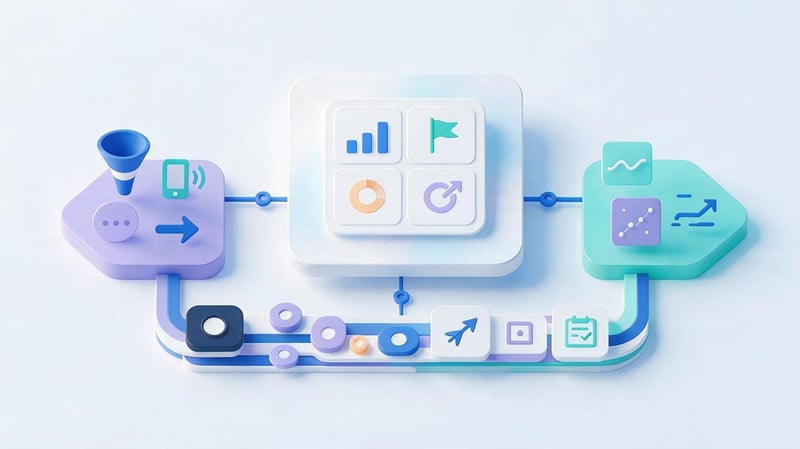
A mobile app promotion strategy describes which users a company intends to attract, through which sources, and with what budget. It also outlines the timeframe, responsible specialists, success metrics, and conditions for adjusting the chosen approach.
A mobile app marketing strategy should take into account the product's stage of development. A new service needs to validate audience interest, while an existing app can focus on reducing acquisition costs and increasing repeat purchases.
Setting goals and KPIs
Formulate goals that can be verified using analytics data. Instead of simply increasing app popularity, define the desired number of registrations, the cost per acquired customer, or the acceptable cost of a new subscription.
For a product with a paid subscription, it's useful to consider the number of users who completed the trial period and started paying. For a free app with ad monetization, usage frequency, session duration, and revenue from the active audience may be more important.
Each goal should have a measurement period and a clear data source. For example, the team might set a goal of achieving the first 200 registrations within a month and identifying which channels generate the best user retention. Project-specific figures are determined based on the product's economics, not based on general recommendations.
Selecting a marketing model and positioning
The monetization method influences the acceptable acquisition cost. If the app is sold for a fixed price, revenue from the purchase and platform fees must be taken into account. For subscriptions, the duration of use and the likelihood of renewal are important.
A freemium product offers basic functionality for free, while additional features are paid for separately. Therefore, the team must understand what portion of the audience is upgrading to a paid plan and how this metric varies across channels.
Positioning is built around a specific benefit. For example, an expense tracking app might be presented through quick purchase entry, shared family budgeting, or automatic expense allocation. The chosen benefit must be supported by the product's actual features.
Distribution of tasks between channels

Mobile app promotion channels vary in terms of speed and cost. ASO helps leverage existing search demand, advertising attracts additional audiences, and useful publications gradually create their own traffic sources.
At the beginning, it's best to select a few channels that align with the target audience's behavior. Launching a dozen channels simultaneously with a small budget complicates measurement and doesn't provide enough data to evaluate each source.
Allocate resources based on team tasks. For example, a designer prepares materials for store listings, a marketer sets up advertising campaigns, an SEO specialist works on the website, and an analyst monitors events and results.
Strategy for a new app
A new app primarily needs its first interested users and the ability to test key hypotheses. Start with a limited set of features, a clear product description, and a small audience willing to share their impressions.
After fixing critical errors, prepare store listings, set up analytics, and run your first advertising tests. At the start, it's more useful to understand why users install and continue using your app than to achieve a large number of random downloads.
Don't increase your budget just because your cost per install is low. Compare subsequent user behavior: registration completion, key feature use, and repeat openings.
Strategy for an existing app
An existing app usually already has a history of installs, user events, and advertising costs. Start by auditing this data to find the sources that drive active audiences and identify the most problematic stages of the funnel.
Then, check the conversion rates of your App Store and Google Play listings, retention rates, and advertising campaign results. Based on this analysis, you can update your visuals, revise your ads, and improve your first user interactions.
Scaling should begin after confirming consistent results. If advertising attracts buyers at an acceptable cost, the budget can be gradually increased, while continuing to monitor ROI and the quality of new cohorts.
What are the methods and channels for promoting mobile apps?
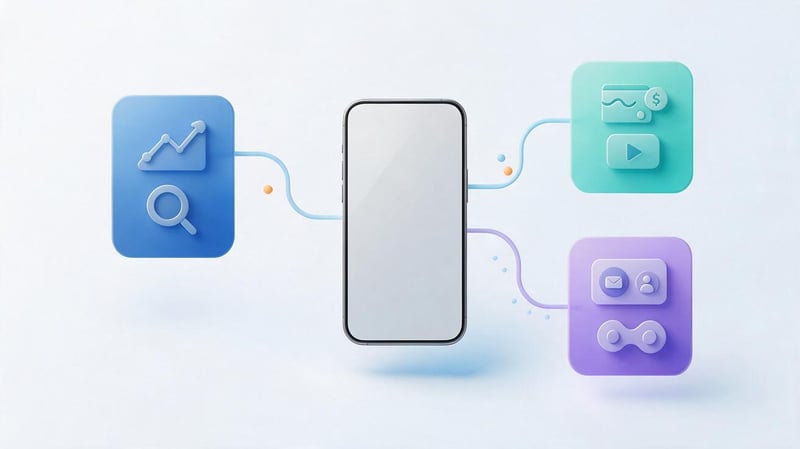
Mobile app promotion methods are typically divided into organic, paid, and affiliate. This distinction helps understand what a company pays for directly, what resources it spends on content production, and how it acquires users through recommendations.
The choice depends on how familiar the audience is with the product category. For example, a document scanning app can be promoted using existing search queries. A new service with an unusual feature may require additional publications and demo videos explaining the concept.
| Channel | Type of promotion | The main task | When to expect the first data |
|---|---|---|---|
| ASO | Organic | Listing visibility and conversion | After indexing and accumulation of impressions |
| Website SEO | Organic | Search traffic from Google | After indexing and increased visibility |
| Social media | Organic or paid | Introducing the product to the audience | After publishing or running ads |
| Apple Ads | Paid | Attracting App Store users | After the launch and start of impressions |
| Google App Campaigns | Paid | Installs and in-app actions | After launch and data accumulation |
| Advertising with bloggers | Paid or affiliate | Reaching the relevant audience | During and after placement |
| Referral program | Organic with possible costs | Inviting existing users | After starting the program |
The speed of initial data availability is not the same as the payback period. A channel can quickly generate installs, but assessing retention and repeat purchases will require additional time.
Organic promotion methods
Organic mobile app promotion helps you acquire users without paying for every click. However, it requires preparing materials, regularly working with the product, and analyzing the results.
These channels are especially useful when an app solves a known problem that people are already searching for online or in stores. If demand for a feature is virtually nonexistent, organic acquisition may be slow to develop.
Typically, they start by optimizing the app's store listing and website. Then they add articles, helpful publications, and participation in relevant communities where potential users already interact.
ASO promotion in app stores
ASO optimization aims to increase app visibility in the App Store and Google Play, as well as the proportion of app store visitors who install the product. This is achieved through work with text metadata, visual assets, localization, and user experience.
First, they collect search queries that people might use to search for the app. Then, they distribute relevant phrases across the available store fields and check how well the design communicates the app's key benefits.
Results are assessed based on search visibility, listing views, and install conversion rates. However, ranking changes can depend on many factors, so a single edit to the title or description cannot be considered a guarantee of growth.
SEO promotion of a mobile app website
A dedicated website helps attract people from Google for queries that aren't always easily captured by a store listing. It can showcase features in detail, explain use cases, answer questions, and prompt installation.
For SEO promotion, a product landing page, a section with features, and useful articles are prepared. For example, a financial management app might generate traffic from content on budget planning, subscription management, and expense analysis.
A user-friendly mobile version, fast loading times, clear headlines, and accurate store links are essential. Results are measured in Google Search Console and GA4, with additional tracking of conversions to installation pages.
Content marketing and social media
Content helps demonstrate the app in action before people decide to install it. Short instructions, feature overviews, comparisons of problem-solving methods, and answers to audience questions are all suitable for this purpose.
Formats are selected based on the product's specific features. For a photo editing app, demonstration videos are useful, while for a financial service, breakdowns of typical expenses and practical recommendations are helpful.
Posts on YouTube, TikTok, Instagram, and other accessible channels should lead to a clear next action. This could be an installation, a subscription to updates, or a link to the page for the feature featured in the post.
Paid promotion methods
Paid advertising helps quickly test audience interest and attract users from sources where the app is little known. Common options include advertising in stores, Google Ads campaigns, social media, and within other apps.
Each channel has its own settings, ad formats, and optimization methods. Therefore, before launching, you need to determine which event will be considered a result: an install, registration, purchase, or subscription.
It's best to conduct initial tests with a limited budget and several creative options. After accumulating data, compare the cost of target actions and the quality of acquired users, rather than choosing a winner based solely on click volume.
Affiliate and referral mechanics
Affiliate promotion is built on collaboration with companies, creators, and communities interested in the app's audience. For example, a workout planning service might partner with fitness trainers, sports bloggers, and event organizers.
A referral program encourages existing users to recommend the app to their friends. The reward can be an additional feature, a bonus period, or another clear benefit, as long as such a mechanism complies with the platform's rules.
Referral links, promo codes, or internal invitation IDs are used to evaluate the program. It's important to monitor the activity of invited users and prevent abuses associated with the creation of fake accounts.
How to optimize an app for the App Store and Google Play?
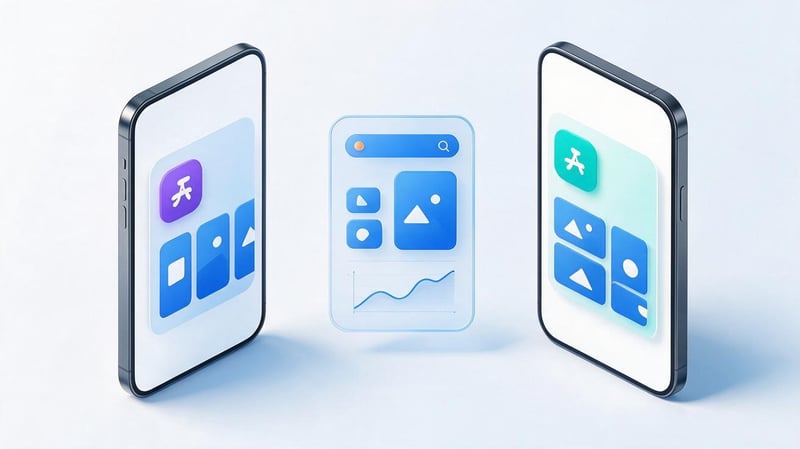
Store listing optimization begins with query analysis and continues after the app is published. Over time, new competitors emerge, user needs change, and your own product gains additional features.
The App Store and Google Play use different metadata fields, so a single, ready-made text can't be transferred between platforms without modification. Both listings must consistently explain the product's purpose and showcase its true capabilities.
Collecting a semantic core for ASO
The app's semantic core consists of queries that potential users use to describe the features they need. For example, for a home workout service, these might include exercise names, workout programs, and specific goal statements.
First, search suggestions and queries are collected from ASO tools. Then, the relevance, popularity, and competitiveness of each variant are assessed. Competitors' brand names and irrelevant keywords should not be included for the sake of potential reach.
It's useful to categorize queries into brand, category, and functional ones. Research is conducted separately for different languages and countries, as the direct translation of a keyword often doesn't match actual search behavior.
Optimizing listing text elements
Text elements should quickly explain what the app can do and who it's suitable for. Users browse through numerous search results, so vague wording is inferior to a specific description of the features.
The title, short text fields, and visible portion of the description are checked first. When adding keywords, platform rules, length restrictions, and sentence readability must be taken into account.
Avoid listing queries separated by commas where the store expects regular user text. If the description looks like a bunch of keywords, it doesn't explain the product as well and may violate metadata requirements.
App Store title, subtitle, and keywords
In the App Store, the app title and subtitle are limited to 30 characters each. There's a separate field for keywords, limited to 100 bytes, so it's especially important to choose relevant phrases without unnecessary repetition.
The title should help identify the product, and the subtitle should clarify its primary purpose. Additional queries should be included in the keyword field, taking into account Apple's guidelines on repetition and acceptable expressions.
The description thoroughly explains the app's features and benefits. However, when planning ASO, it's not possible to consider all text fields equally important in terms of their impact on App Store search.
Google Play title, short and full description
On Google Play, app titles are limited to 30 characters, short descriptions to 80 characters, and full descriptions to 4,000 characters. These fields should be filled in with a view to the product's actual features and target audience search queries.
A short description helps quickly understand the app's purpose. A full description explains the features, terms of use, and key scenarios, but shouldn't devolve into repeating a single keyword.
Google prohibits misleading claims and metadata manipulation. Therefore, avoid making unsubstantiated promises, mentioning other brands, or making artificial claims about store leadership.
Optimization of visual materials

Icons and screenshots often influence a user's decision before a detailed description. They help people evaluate the app's purpose, interface quality, and the usability of its key features.
It's best to structure screenshots into a coherent story. The first one demonstrates the main benefit, while the subsequent ones introduce key scenarios and help visualize how the product is used in everyday life.
Avoid overloading images with small text. Long captions are difficult to read on a small screen, so each image should convey a single, clear message and demonstrate the actual interface.
Application localization
Localization helps adapt a product to users in a specific country and language. In addition to translating the interface, it's important to consider function names, search terms, date formats, currencies, and common usage scenarios.
For example, Ukrainian and English audiences may describe the same need differently. Therefore, the semantic core for each language is compiled separately, and advertising messages are tested for relevance to the local context.
Visuals may also require changes. If screenshots show the interface in a different language or an inappropriate currency, some users may conclude the app is not intended for their region.
Working with ratings and reviews
Reviews help developers identify problems and new users evaluate the app's reliability. Comments in which people describe specific bugs or issues with features are especially helpful.
Regularly analyze recurring complaints, respond to questions, and announce fixes. It's best to prompt a rating request after a positive user experience, using the platform's built-in mechanisms.
Purchasing fake reviews and artificially inflating installs creates the risk of sanctions. Apple and Google prohibit the manipulation of ratings and popularity metrics, so an app's reputation must be nurtured through product quality and feedback management.
A/B testing of the app store listing
A/B testing helps compare listing design variations based on real visitor behavior. For example, a team can test two screenshot sequences or different wording of a key benefit.
Before the experiment, a hypothesis is formulated and the primary metric is selected, typically the conversion rate from listing views to installs. Then, the test conditions are determined and sufficient data is collected to interpret the results.
Don't change all elements at once and attribute the improvement to just one. Also consider the impact of seasonality, advertising campaigns, and differences between countries to avoid mistaking random fluctuations for a consistent effect.
Free mobile app promotion: which methods work?
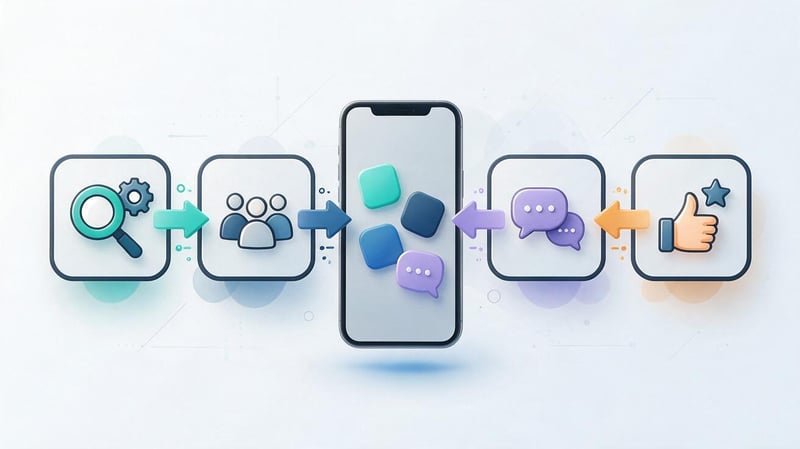
Free mobile app promotion is especially attractive to small teams and independent developers. However, the lack of advertising fees doesn't eliminate the costs of preparing publications, creating content, and engaging with the audience.
These methods are suitable for initial demand testing and the gradual development of organic acquisition sources. Channels that already have a strong presence of people who share the needs the app addresses typically yield the greatest benefits.
Promotion through your own website and blog
You can start with a simple landing page that explains the app's purpose and includes links to stores. Add a demo of the interface, key features, answers to questions, and the developer's contact information.
Next, prepare several materials on topics related to user tasks. For a language learning app, these could include articles on self-study, vocabulary training, and choosing a learning mode.
SEO website promotion requires time for indexing and visibility. However, useful pages can continue to receive search traffic after publication if the information remains relevant and answers user queries.
Promotion in social networks and communities
For a small app, it's more useful to select one or two niche communities than to publish identical ads on every available platform. Look for places where users are discussing the problem your product addresses.
On Reddit, Discord, specialized forums, and social media, it's best to start with substantive answers and demonstrations of specific solutions. Direct advertising should only be posted where community guidelines allow it.
Publications can feature short usage scenarios, bug reports, and new features. Keep in mind that discussion participants' interest doesn't always translate into installs, so measure conversions and subsequent audience actions.
PR and publications in specialized media
Editors are more interested in stories with useful information than standard app launch announcements. Prepare a story about a user problem, the results of a short study, or an unusual approach to solving a problem.
The press kit should include a brief description of the product, high-quality images, links to stores, and contact information for a team representative. If the app has verified user results, these can be included with the necessary context.
Choose media based on the topic and geography of your audience. Publishing in a major publication may generate few relevant installs, while a smaller industry resource can sometimes attract interested users.
Referral program and user recommendations
Free mobile app promotion can be supplemented by recommendations from existing audiences. This approach is especially suitable for services that people use together or naturally tell their friends about.
For example, a family shopping planner app might offer to invite another list member. The user gains practical benefits from the invitation, and the developer gains new connections with a potential audience.
If the program offers bonuses, calculate the costs and restrictions in advance. Monitor the quality of the accounts you invite and don't tie rewards to fake reviews or artificial installs.
How to get your first 100 users without an advertising budget?
Early adopters are needed to test real demand and product quality. Building a large audience right away isn't necessary: at the early stages, a few dozen active users can provide more useful information than hundreds of random installs.
Start by identifying small groups that truly need the app's features. Prepare a brief explanation of the product and offer to test it without complicated registration or unnecessary obligations.
Practical procedure:
- Find a few communities that regularly discuss the problem the app solves.
- Prepare a demonstration of the main scenario so that the person immediately understands the purpose of the product.
- Invite the first participants to test and explain what feedback will be useful.
- Check how many people installed the app and were able to complete the main action.
- Fix the most common issues and re-invite the next group.
- Ask satisfied users to tell friends who would really benefit from the product about it.
The number 100 is used here as a benchmark for organizing initial testing. Reaching this mark alone doesn't prove the app's popularity, so evaluate the regularity of use and the content of feedback.
How to promote an app using paid advertising?
Paid mobile app promotion methods help drive traffic from stores, search engines, social media, and advertising networks. They're ideal for testing demand, attracting new users, and scaling channels with proven results.
Before launching, it's important to prepare event measurement and determine an acceptable acquisition cost. If the app is monetized through subscriptions, evaluating campaigns based solely on cost of install will not be sufficient.
Advertising in the App Store via Apple Ads
Apple Ads offers ad placement within the App Store, including search results. This format is suitable for attracting people who are already searching for apps of a specific category or feature.
Campaigns are set up using relevant search queries, geography, bids, and available product page options. Ads can be based on the app's main store listing or specially prepared design options.
Effectiveness is assessed based on costs, installs, and subsequent actions of the acquired audience. If one set of queries generates a large number of installs but almost no active users, it should be reviewed separately.
Google App Campaigns
Google App Campaigns are used to promote apps within Google's advertising ecosystem. Advertisers provide the necessary assets, select objectives, and configure available campaign parameters, and the system distributes impressions across suitable placements.
To launch, you'll need an app, a linked advertising account, creatives, and properly configured events. Depending on available features and data volume, you can optimize campaigns for installs or specific in-product actions.
Pay special attention to the quality of the initial events. If the target action is a technical screen open instead of a confirmed purchase, the ads will optimize for the wrong result.
Meta Ads and TikTok Ads
Social advertising platforms are suitable for apps whose benefits can be quickly demonstrated through an image or video. A short demo of a feature can sometimes explain the product more clearly than a detailed text ad.
To launch, prepare several creatives with different user scenarios. One version might demonstrate a problem, another a specific app feature, and a third the process of achieving a result.
Measure clicks, installs, registrations, and purchases using available mobile attribution mechanisms. Device privacy settings may limit the accuracy of individual reports, so discrepancies between systems must be taken into account during analysis.
In-app advertising and mobile ad networks
In-app advertising is displayed within other mobile apps. This channel is widely used to promote games, but can also be suitable for services with a well-defined mass audience.
Common formats include banners, full-screen ads, rewarded videos, and interactive ads. For example, playable ads allow users to try specific gameplay elements before installing them.
When choosing a network, consider traffic geography, availability of desired formats, and attribution quality. Cheap installs from inappropriate apps can lead to users who quickly churn and fail to complete their desired actions.
Promotion through bloggers
Blogger advertising is suitable for apps that prioritize credibility and clear explanations of features. When choosing a blogger, consider the topic, geography of their followers, the nature of their interaction with the audience, and their past advertising placements.
A good integration demonstrates how the app solves a specific problem. The author can demonstrate the registration process, the main function, and the result of use, if the experience truly matches the product.
Individual links, promo codes, and other available tracking mechanisms are used for measurement. In addition to the number of installs, analyze the activity of the users attracted, as high reach of a post does not guarantee commercial results.
How much does it cost to promote a mobile app?
Promotion costs depend on the app category, market competition, country, selected channels, and monetization features. The same number of installs for two different products may require completely different budgets.
When planning costs, consider the work of specialists, the creation of advertising materials, analytical tools, and actual placement costs. It's also helpful to set aside a separate budget for testing new hypotheses.
Pricing models: CPI, CPC, CPM, CPA, and CPE
Pricing for mobile app promotion depends on the advertising platform and the chosen objective. Some models consider impressions or clicks, while others focus on installs or specific in-app events.
The difference between them affects risk distribution. With pay-per-impression, the advertiser gets the opportunity to reach an audience, but not a guaranteed install. With pay-per-action, the calculation is tied to a specific result, although its quality still needs to be verified.
| Model | What is charged for | When it is used |
|---|---|---|
| CPM | Per 1000 ad impressions | Reach and media campaigns |
| CPC | For clicking on an advertisement | Pay-per-click campaigns |
| CPI | Per app install | Acquiring new installs |
| CPA | Per agreed target action | Registrations, purchases, and other conversions |
| CPE | For a certain interaction | Engagement campaigns |
The pricing model shouldn't be confused with the advertising system optimization method. For example, a campaign may use a target cost per action, while the actual billing scheme is different.
How to calculate a test budget?
For an initial calculation, determine how many installs you need and what cost per install your business can afford. These values are best derived from product economics, past campaigns, or small preliminary tests.
Let's consider a hypothetical example: a team plans to get 500 installs and assumes an average cost per install of $2. The estimated advertising budget will be $1,000 if the actual CPI matches the assumption.
Calculation formula:
Advertising budget = planned number of installs × expected CPI.
In the given example: 500 × 2 = 1000 USD.
This is a model calculation, not a confirmed market price per install. In a real campaign, the cost will vary depending on the quality of the ad, the audience, competition, and other factors.
The resulting sum is supplemented by the costs of creative development, analytics, testing, and specialist work. To assess commercial effectiveness, it's also necessary to understand how many acquired users will make purchases or subscribe.
How to choose between free and paid channels?
With a small budget, it's wise to start with ASO, useful content, and working with relevant communities. These efforts take time, but they help build an early audience and understand their needs.
Paid channels are useful when you need to get data faster or increase installs. However, scaling up advertising should be done after verifying key user actions and acceptable acquisition costs.
The optimal distribution depends on the team's resources. If the developers can independently manage the blog and publish content regularly, organic sources can make up a significant portion of the strategy. With budget and proven product viability, paid advertising helps accelerate growth.
How to retain users after installing an app?
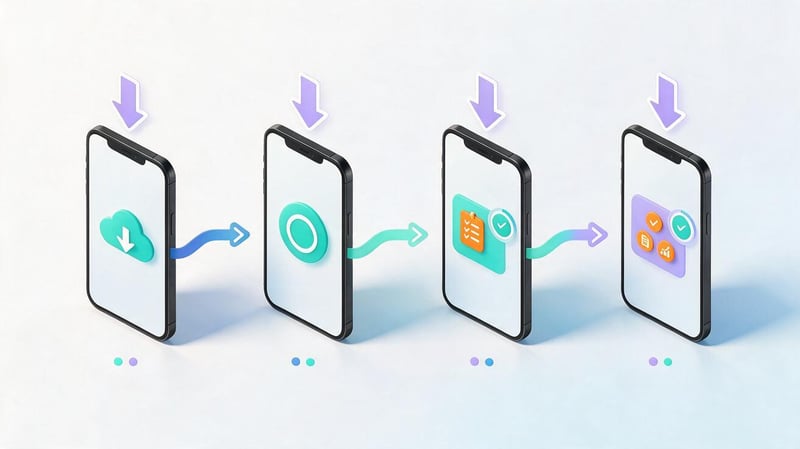
Acquisition ends with the installation only in the advertising report. For a product, the process of engaging with a new user continues when the person opens the app, explores its features, and decides whether to return.
User retention depends on the quality of the product, the ease of use of key actions, and how quickly users receive the expected benefit. Problems at this stage increase the actual cost of acquiring an active audience.
Onboarding and the first product value
Onboarding helps users navigate the app after the first launch. Its purpose is to guide users to the important action without forcing them to read lengthy instructions or fill out unnecessary fields.
For example, in a budgeting app, the first useful action might be adding an expense. If that requires going through ten setup screens, some users might abandon the app.
Check how long it takes from opening the app to receiving the first result. Compare the behavior of users who completed the initial scenario with those who stopped early.
Push notifications, email, and in-app messages
Communications help remind users about useful features and return them to unfinished tasks. For example, a language learning service might prompt users to continue a lesson, or a delivery app might notify them of an order status change.
Messages should be tailored to a person's actions and preferences. Too frequent notifications can be annoying, so it's important to control frequency and provide the ability to customize communication settings.
Push notifications, email, and in-app messages are used for re-engagement. The effectiveness of each format is assessed based on targeted actions and retention, not just open rates.
Personalization, recommendations and loyalty
Personalization helps display features and offers that suit the user's needs. For example, a workout app might take into account the user's chosen fitness level, available equipment, and workout goal.
Loyalty programs are suitable for products with repeat purchases or regular use. Bonuses should be clear, and the conditions for earning them should be transparent.
Don't introduce a complex rewards system before validating the app's core value. If users don't return due to bugs or an inconvenient interface, extra points and discounts may temporarily mask the problem but won't address the root cause.
How to measure the effectiveness of mobile app promotion?
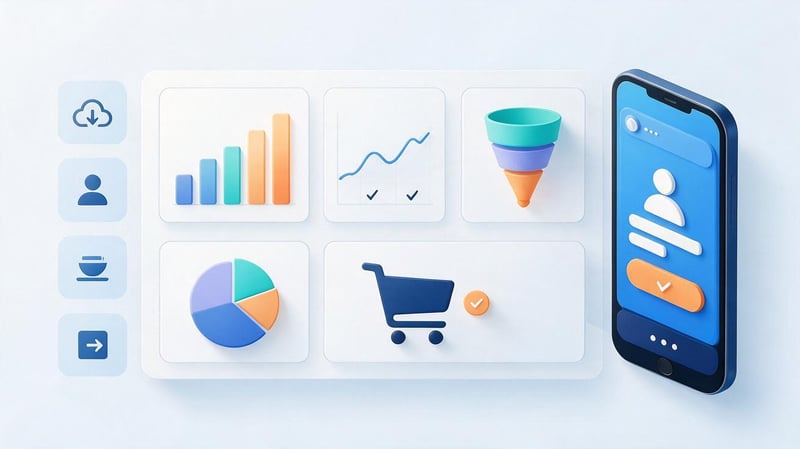
To evaluate promotion, it's necessary to link advertising costs to user actions after installation. This approach helps compare channels based on their actual product benefit and make budget allocation decisions.
Mobile app promotion, acquisition methods, and effectiveness should be considered together. A low cost per install may seem attractive, but with weak retention and a lack of payments, this source will be unprofitable.
Key mobile marketing metrics
Metrics are selected based on the app's business model and development stage. At launch, the focus is often on installs and activation, while as the app scales, retention, revenue, and return on investment become more important.
To understand results, it is useful to separate the metrics of advertising exposure, installation, product usage, and monetization.
| Metrics | What does it show? | What is it used for? |
|---|---|---|
| Impressions | Number of ad impressions | Coverage assessment |
| CTR | Share of clicks from impressions | Evaluating the attractiveness of an ad |
| Store conversion rate | Share of installations from the selected number of listing views | Store conversion analysis |
| CPI | Average cost per install | Controlling acquisition costs |
| CPA | Cost per target action | Evaluation of registrations or purchases |
| Activation rate | Percentage of users who reached the activation event | Testing the first experience |
| Retention D1, D7, D30 | The proportion of users who returned during the corresponding period | Retention assessment |
| DAU and MAU | Number of active users per day and month | Audience activity analysis |
| ARPU | Average revenue per user for the selected period | Monetization assessment |
| LTV | Expected or actual user lifetime value | Long-term income assessment |
| CAC | Customer acquisition cost according to the accepted methodology | Control of acquisition economics |
| ROAS | Attributed advertising revenue to advertising expenditure ratio | Evaluation of advertising returns |
When comparing metrics, use consistent time periods and event definitions. For example, retention may be calculated using different return rules, so data from different services may not always match.
Analytics and attribution tools
Firebase and Google Analytics help track in-app activity and analyze user scenarios. App Store Connect and Google Play Console provide data related to relevant stores, installs, and audience behavior in accessible reports.
Mobile attribution systems, including AppsFlyer and Adjust, are used to link advertising engagement to installs and subsequent events. However, using MMP requires proper SDK integration or other supported mechanisms.
Platform privacy restrictions impact the completeness of advertising data. Therefore, discrepancies between reports from stores, advertising accounts, and analytics systems must be investigated and not automatically dismissed as errors on the part of one party.
How to determine the effectiveness of each channel?
Compare users acquired from different sources at similar stages of the user lifecycle. For example, two campaigns may have the same cost per install but differ significantly in their registration and purchase rates.
Cohort analysis helps you see how groups of users who arrived during a specific period behave. For commercial apps, it's especially useful to compare costs with revenue and retention over a given time period.
Lead SEO specialist — Gennady
I recommend evaluating mobile app promotion not only by the number of installs and rankings in the App Store or Google Play. These metrics help us understand how well the acquisition is working, but they don't indicate whether the audience is bringing value to the business. Therefore, I always suggest linking ASO, SEO, and advertising channels to specific user actions: registrations, purchases, and repeat visits. If an app gets a lot of installs but users quickly leave, increasing the advertising budget won't solve the problem. First, you need to understand the quality of the traffic and the product itself, and only then scale up the promotion.
This approach helps identify sources of high-quality audiences and avoid wasting budget on metrics that only look good in the advertising account. Use data from multiple periods and consider possible attribution limitations when making decisions.
A step-by-step plan for promoting a mobile app in 90 days
It's more convenient to break a mobile app promotion plan into short stages with specific deliverables. The first 90 days can be used to prepare the product, test hypotheses, test advertising channels, and lay the foundation for further growth.
This schedule is suitable as an example of how to organize the work, but it doesn't guarantee a specific number of installs or profit. The timelines for individual tasks depend on the app's maturity, team size, and available budget.
Days 1–14: audit and preparation
In the first stage, define the main promotion goals and describe the target audience. Then, research your competitors, collect queries for ASO, and check the app's technical stability.
At the same time, set up analytics and agree on key event names. It's especially important to check registration, activation, and payments if the app is monetized.
By the end of this stage, the team should have a list of key hypotheses, a prepared measurement system, and a list of bugs that need to be addressed before involving a large number of users.
Days 15–30: optimization and first users
Prepare App Store and Google Play listings, including titles, descriptions, icons, and screenshots. Check for localization availability and ensure visual assets match the current app version.
Launch your first organic activities: posts in relevant communities, helpful content on your website, and user testing invitations. If you have the budget, you can conduct small advertising experiments.
The main result of this stage is the initial data on how users find the application, why they install it, and what difficulties they encounter during initial use.
Days 31–60: channel testing
After the initial installations, move on to comparing channels and ad messages. Prepare several creative options, test relevant audiences, and monitor the cost of targeted actions.
Simultaneously analyze store listing conversion rates and onboarding results. If users frequently abandon registration, first determine the reasons and then decide whether to increase your advertising budget.
At the end of this stage, you should identify the most promising sources and discard any hypotheses that haven't been confirmed. Make your decision based on the quality of your audience and the adequacy of the data collected.
Days 61–90: optimization and scaling
In the final stage, focus on channels that attract users at an acceptable cost and with good retention rates. Update your advertising materials, adjust your audience segments, and improve key stages of the funnel.
If necessary, revise your semantic core, listing images, and website content. For ongoing campaigns, continue to monitor acquisition costs, retention, and monetization.
By the end of the period, the basis for the next marketing plan should appear: confirmed hypotheses, working traffic sources, and a list of tasks for improving the product.
| Period | Basic steps | Responsible | Benchmarks |
|---|---|---|---|
| Days 1–14 | Audit, audience, analytics, ASO semantics | Marketer, analyst, developer | Event and product readiness |
| Days 15–30 | Store listings, first publications and tests | ASO specialist, content team | Impressions, installations, activation |
| Days 31–60 | Advertising experiments, creative testing | Advertising specialist, analyst | CPI, CPA, retention |
| Days 61–90 | Optimization, budget redistribution | Marketer, product team | LTV, ROAS, cohort dynamics |
At the end of each period, document the results and changes in a single document. This will help you separate truly useful actions from mere coincidences and make faster decisions at the next stage.
What tools are needed to promote a mobile app?
Tools are selected for specific tasks: competitor research, store listing optimization, advertising, attribution, and user retention. A large number of connected services does not guarantee high-quality analytics if the team hasn't defined the data it needs.
For a small project, console-based store tools, basic product analytics, and a single advertising account are often sufficient at the start. Additional platforms are added as the number of channels and the complexity of measurement grows.
| Tool | Main purpose | Who is it suitable for? |
|---|---|---|
| AppTweak | ASO and search visibility research | For ASO specialists |
| Sensor Tower | Market and competitive environment analysis | For marketers and analysts |
| ASOdesk | Working with queries and app store listings | Mobile product teams |
| Firebase | Product analytics and events | For developers and analysts |
| App Store Connect | App management and Apple reports | For iOS product developers |
| Google Play Console | Publishing management and store analytics | For Android product developers |
| AppsFlyer | Mobile attribution | Advertising and analytics teams |
| Adjust | Attribution and campaign measurement | For mobile marketers |
| Apple Ads | Advertising within the App Store | For iOS app advertisers |
| Google Ads | User acquisition campaigns | For mobile app advertisers |
| OneSignal | Push notifications and communications | Product teams |
| Braze | Automation of interaction with users | For teams with advanced CRM |
| Google Search Console | Organic search analysis | For SEO specialists |
| GA4 | Analysis of events and traffic sources | For marketers and analysts |
The terms of free plans, trial periods, and paid features vary, so please check them before signing up. When choosing, also consider user data processing requirements, integration options, and support availability.
What mistakes hinder mobile app promotion?
Many advertising performance issues arise even before campaigns are launched. Incorrectly targeted audiences, app bugs, or a lack of analytics hinder user acquisition and increase the cost of further development.
It's especially dangerous to scale costs without understanding what happens after installation. In this case, the team could spend a long time paying for traffic that has virtually no impact on commercial performance.
The most common mistakes:
- Lack of a specific audience. Advertising reaches too wide a range of people, among whom there are few potential users of the product.
- Promoting an unstable application. Errors during registration, launch, or payment lead to the loss of an already attracted audience.
- Ignoring ASO. Uninformative titles and weak screenshots reduce the likelihood of installation after viewing the listing.
- Advertising without analytics. The team sees costs and installs, but doesn't understand what sources are driving registrations and purchases.
- Evaluating installs only. Cheap downloads can be accompanied by low retention and a lack of useful actions.
- Lack of retention analysis. Developers continue to increase acquisition, although most users quickly stop opening the app.
- Blind copying of competitors. Other people's advertising messages and channels may not match the audience of your own product.
- Using fake boosting. Fake reviews and artificial installations create the risk of restrictions from stores.
- Lack of localization. An inappropriate interface language and listing language reduces user trust in the selected country.
- Premature scaling. The advertising budget is increased before the cost of target actions and acquisition economics have been verified.
To avoid these mistakes, regularly compare marketing metrics with actual product usage. Fixing in-app issues is often less expensive than constantly acquiring new installs to replace lost users.
Proper mobile app promotion begins with understanding the audience and preparing the product itself. The team then selects the appropriate channels, optimizes the App Store and Google Play listings, sets up analytics, and tests initial results.
Successful promotion is determined by the quality of acquired users, their activity, and commercial performance. Regular testing, retention management, and cost control help develop the app without unjustified increases in advertising budgets.
Need a mobile app promotion strategy? Contact Seo-Gen for search demand analysis, SEO and ASO assessment, acquisition channel selection, and a work plan with measurable metrics.


