How to conduct SEO competitor analysis?


Competitor SEO analysis helps you understand which pages, queries, links, and solutions other websites rely on to gain visibility in Google. The results can help you identify missing semantics, weak sections of your own website, new content topics, and technical growth opportunities.
It's best to start your analysis with search results, as well-known companies in your niche don't always compete with your website for organic traffic. For certain queries, aggregators, marketplaces, directories, media outlets, or information projects may rank high, capturing a significant portion of search traffic.
Next, we'll look at how to analyze SEO competitors, where to find data, how to check a competitor's website, how to collect its semantics, and what to do with the information obtained.
What is SEO competitor analysis and why do it?
SEO competitor analysis is a comparison of websites competing for visibility for the same or similar search queries. It evaluates the semantic core, organic traffic, structure, landing pages, content, technical SEO, internal linking, and link profile.
This analysis helps identify solutions that are already working within a specific niche. If several top-10 sites use separate pages for cities, services, or information clusters, it's worth testing this pattern on your own project.
The analysis also reveals the gap between the site and the top search results. For example, a competitor may receive organic traffic from hundreds of categories, while on your site, the same queries lead to a single, generic page.
What tasks does competitor analysis solve in SEO?
The main goal is to identify areas where your website is inferior to other search results. This is done by comparing the number of relevant pages, search queries, rankings, content, internal links, and referring domains.
As a result, several types of gaps can be identified:
- The semantic gap shows queries and clusters that are not in the current core;
- structural gap indicates missing categories, services, filters and landing pages;
- Content Gap shows you topics where your competitors are already gaining visibility;
- Link Gap helps you find sites that link to multiple competitors;
- The technical gap shows differences in indexing, speed, Schema.org, URLs, and multilingualism.
After verification, each identified gap is translated into a specific task. The task must have a priority, a landing page, and a clear expected outcome.
How is an SEO competitor different from a business competitor?

A direct business competitor sells a similar product or service to the same target audience. A search competitor regularly overlaps with your website in Google's organic search results and targets the same search queries.
These groups often overlap, but there's usually no complete overlap. For example, a private clinic competes for patients with other clinics, but its pages may compete with medical portals and major directories for informational queries.
SEO requires both groups. Direct competitors help you understand the market and your business proposition, while search competitors highlight SERP requirements for page structure and content.
Direct competitors
Direct competitors include companies with similar services, product range, region, and audience. They can be easily found through Google, Google Maps, industry directories, advertising, and well-known brands within the niche.
After compiling the list, it's worth checking the search visibility of each domain. A company may be a major market player but receive little organic traffic and therefore provide little useful data for SEO comparison.
Search competitors
Search competitors are identified based on actual search results. This is done by selecting several priority clusters, checking the top 10, and identifying domains that are regularly repeated for different queries.
Particular attention should be paid to sites with similar page intent. It's more accurate to compare an online store's commercial category with other categories, and an informational article with materials Google displays on the same topic.
Why can’t you analyze only 1-2 websites?
One competitor may have an unusual structure, a strong brand, or a link profile that's difficult to replicate. If you focus solely on this, it's easy to mistake an individual decision for the overall niche pattern.
For most projects, selecting 5-10 websites is sufficient. Recurring elements across several leaders provide a more useful guide: page type, structure depth, content format, trust blocks, internal linking, and semantics.
Lead SEO specialist — Gennady
I start my analysis not with a list of well-known brands, but with search results. I select several priority clusters and look at which domains consistently appear in the top 10. Then, I compare their semantics, structure, content, and links with our website. This approach reveals specific SEO gaps and helps me immediately formulate a list of tasks.
Answers to your questions
How to conduct SEO competitor analysis?
First, find websites that regularly appear in Google for the main clusters. Then compare their search queries, organic traffic, structure, content, technical SEO, internal links, and link profile.
The results should be summarized in a Gap table. For each gap found, indicate the page, action, and implementation priority.
How to find your website's competitors?
Check Google's top 10 rankings for several commercial and informational clusters. Note down domains that are regularly repeated, and then check for semantic overlap using Ahrefs, Semrush, or Serpstat.
This approach helps you distinguish established market players from sites that are actually competing with you for organic traffic.
How can I find out what queries my competitor is using to rank?
Open the Organic Keywords report in one of the SEO services. It shows keywords, positions, search volume, landing pages, and estimated search traffic.
After exporting, remove irrelevant and branded queries. Distribute the remaining keywords into clusters and compare them with your semantic core.
How to find out a competitor's website traffic for free?
Free versions of SEO services provide limited data on visibility, queries, and traffic. This data is sufficient for a preliminary check of a few domains.
It's impossible to accurately determine someone else's website traffic without access to their internal analytics. Therefore, free metrics are best used for relative comparisons.
How to analyze a competitor's website?
Check its structure, indexed pages, Title, Description, H1, H2-H3, content, technical settings, and internal linking. Then, examine organic queries, Top Pages, and the link profile.
It's best to compare several websites simultaneously. Repeated decisions provide a more reliable benchmark than the specifics of a single project.
How many competitors do you need to analyze?
For most SEO tasks, 5–10 relevant domains are sufficient. This number can be increased in a large niche where search results vary significantly between clusters.
The main criterion is the overlap of search queries and intent. A large list of random companies rarely improves the quality of the analysis.
How to collect a competitor's semantic core?
Export Organic Keywords from several websites, remove branded and irrelevant queries, merge the data, and remove duplicates. Then add search volume and perform clustering.
Afterwards, compare the resulting groups with your core. This will help you identify new clusters and pages that require expansion.
Is it possible to find out the exact conversion or sales of a competitor?
Without access to CRM, GA4, and other internal systems, accurate metrics are unavailable. Public financial data can only be used when a company actually discloses it.
Estimation models are acceptable for internal planning. Their results should be labeled as approximate, and potential error should be taken into account.
How to properly conduct competitor analysis and avoid copying someone else's website?
Compare multiple domains and look for recurring search results patterns. Use them as a guide for page structure and completeness, and tailor your solution to your specific semantics, product, and audience.
It's helpful to specifically note what competitors aren't doing or are doing poorly. These observations often provide ideas for improving UX and content.
How to find competitors for SEO analysis?

If you need to understand how to find competitors in your niche, it's best to start with the queries that your site should be receiving traffic from. A single general keyword isn't enough, as the SERP composition can vary significantly between commercial, informational, and location-specific queries.
It's convenient to compile the list in a table. For each domain, it's worth indicating the competitor type, geography, key overlapping clusters, estimated visibility, and the pages that appear most frequently in search results.
How to find competitors manually through Google?
First, select several groups of queries related to the project's core products, services, and information topics. Check the search results in the desired region and language, as competitors may differ for Ukraine, Kazakhstan, or a specific city.
The workflow looks like this:
- Collect the main commercial and information clusters of the site.
- Check the Google top 10 for multiple queries within each cluster.
- Write down the domains that appear in search results regularly.
- Separate your direct competitors from aggregators, marketplaces, and information sites.
- Check which specific URLs are ranking for the queries you need.
- Select 5-10 most relevant sites for detailed comparison.
After this, the list can be checked using Ahrefs, Semrush, or Serpstat. This will show how much the domains overlap in search queries.
What queries should I use for my search?
To find competitors, it's best to use several types of semantic keywords. Commercial queries reveal sites competing for leads and sales, while informational queries help identify projects that build an audience through blogs and reference materials.
It's worth including product, category, location-specific, and mid-frequency queries in your sample. If you only check one high-frequency keyword, the results will be too narrow and may poorly reflect the true competitive landscape.
How to identify a real SEO competitor?
A real SEO competitor regularly appears in the same clusters and covers similar search intent. Additional indicators include a similar website structure, a similar promotion region, and overlapping commercial landing pages.
It's useful to look at the share of common keywords. If two sites only overlap on a few random informational queries, a detailed analysis of such a domain will yield little practical benefit.
How to find competitors using SEO services?
Ahrefs, Semrush, and Serpstat find competitors based on overlapping organic keywords. The service compares domains and shows sites that rank for a similar set of queries.
The automatic list needs to be manually verified. Sometimes it includes large portals or marketplaces that overlap on a large number of keywords but operate with a different intent and structure.
For each site found, it's useful to look at Organic Keywords, Top Pages, search visibility, and position distribution. This will make it easier to decide which sites should be retained in the main sample.
How to find competitors' landing pages?
To find your competitors' landing pages, first identify the keyword or product you're interested in. Then, look at the specific competitor URLs that appear for that cluster in organic search results or ads.
You can also check Top Pages and Organic Pages in SEO services. These often display pages for services, categories, cities, and other categories that are difficult to find through the main menu.
If you need to find competitors' landing pages in bulk, download a list of strong URLs from several domains and group the pages by purpose. This will make it easier to compare which types of landing pages are most commonly used in your niche.
What data should be collected before analysis?

Before analyzing competitors, prepare a unified table. If data is collected without a common structure, the comparison quickly turns into a collection of individual metrics, making it difficult to derive website objectives from them.
The minimum set can be completed as follows:
| Parameter | What to record |
|---|---|
| Domain | Competitor's website address |
| Type | Direct, search, aggregator or marketplace |
| Region | Country, region or city of promotion |
| Visibility | Evaluating domain presence in organic search results |
| Traffic | Estimated organic or total traffic |
| Keywords | Number and main thematic clusters |
| Top Pages | Pages with maximum search visibility |
| Structure | Categories, services, blog, filters, geo-pages |
| Content | Volume, structure, tables, FAQ, expert sections |
| Links | Referring Domains, Anchors, Strong URLs |
| Technical SEO | Indexing, canonical, sitemap.xml, hreflang, Schema.org |
| Gap | What's not on your own website |
| Action | What to create, change, or further check |
Each measurement must have a date. Organic traffic, links, and rankings are constantly changing, so comparing data from different periods can lead to misleading conclusions.
It's also useful to save the original downloads. If you repeat the analysis after a few months, you can compare the dynamics and see which of your competitor's pages or clusters have begun to grow.
How to conduct SEO analysis of competitors' websites?
Once the domain list is ready, you can move on to a detailed comparison. It's best to check the sites in the same order to make it easier to compile the data into a single table and identify recurring patterns.
The working diagram looks like this:
SERP → semantics → structure → content → technical SEO → interlinking → links → gaps → tasks
This order helps you move from the big picture to specific pages and not lose the connection between the indicator and the future action.
Step 1: Compare organic visibility and traffic
Start with the big picture: how many queries are in the service's database, what rankings the domain occupies, and which pages generate the majority of organic traffic. Also, look at the dynamics over several months.
It's best to compare identical metrics within a single service. Ahrefs, Semrush, and Serpstat use different databases and evaluation algorithms, so absolute numbers between services may vary significantly.
It's helpful to check the countries and regions where your traffic comes from. An international domain may appear strong in overall statistics, but its visibility in the target region will be significantly lower.
Is it possible to find out the exact traffic of a competitor's website?
Accurate traffic data is available to the website owner through GA4, server-side analytics, and other internal systems. Third-party services estimate traffic based on their own data and models.
Therefore, the question of how to view a competitor's website traffic is best addressed by comparing relative metrics. It's more useful to see which pages are growing and which clusters are delivering significant visibility than to try to get an exact number of visits.
Step 2: Analyze your competitors' keywords
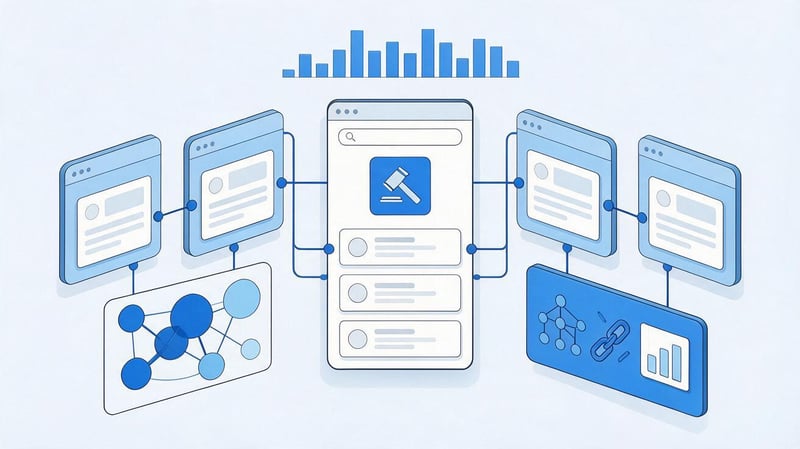
The next step is organic semantics. For each domain, download the query, position, URL, search volume, search intent, and estimated traffic.
After cleaning the data, you'll see which topics competitors cover with separate pages and which queries lead users to a single URL. This data helps you understand how your website's structure is assembled.
Comparing multiple domains is especially useful. If the same cluster is present on three or four leading domains, but your site doesn't have a corresponding page, it's worth checking that direction first.
How can I find out what queries my competitor is using to rank?
The easiest way is to open the Organic Keywords report in Ahrefs, Semrush, or Serpstat. There you can see keywords, current positions, target URLs, and estimated search volume.
The entire export shouldn't be considered a ready-made semantic core. It includes branded, irrelevant, and random queries, so the data is first cleaned and categorized into thematic clusters.
How to collect a competitor's semantic core?
To build a competitor's semantic core, download queries from several relevant domains. Then remove brands, irrelevant topics, and obvious informational noise.
The further order is as follows:
- Combine downloads from several competitors into one table.
- Remove duplicates and irrelevant search queries.
- Add frequency and position data.
- Perform clustering by intent and search results.
- Compare the resulting groups with your semantic core.
- Mark the clusters for which there is no relevant page.
The result will be a list of new directions and topics for expanding existing URLs.
How to make a Content Gap?
Content Gap shows queries for which competitors are already ranking, while your own website is missing or ranks poorly. It's best to check several competitors simultaneously.
The identified queries are divided into two groups. The first requires new landing pages, while the second already has a suitable URL that should be expanded or reworked.
Step 3: Study the structure of your competitors' websites
The structure shows how competitors distribute search demand across pages. Study the menu, sitemap.xml, categories, subcategories, services, city pages, brand pages, tags, filters, and blog.
Then compare several sites. If leaders systematically create separate URLs for a single group of queries, it's worth checking whether this approach is supported by their own semantics and search results.
What types of pages get traffic?
Open Top Pages and sort pages by organic traffic or search volume. This will show you which sections perform best: services, categories, articles, filters, or geo-pages.
You need to pay attention to recurring URL types. One strong article may be a random exception, while dozens of categories with consistent visibility indicate a systematic promotion pattern.
How to find missing sections of your website?
Compare the structure of several competitors with your own. For each topic cluster, note the competing page, the current URL of your own site, and the required action.
The practical format looks like this:
| Cluster | Competitor's page | Our page | Action |
|---|---|---|---|
| Service | There is a separate URL | No | Create a page |
| City | There is a geopage | General page | Check if a separate URL is needed |
| Informational query | There is an article | No | Prepare content |
| Category | Expanded category | Weak category | Expand content |
This approach turns competitor website analysis into a clear task list.
Step 4: Analyze On-Page SEO

For main pages, check the Title, Description, H1, H2 and H3 structure, search intent compliance, content length, images, tables, FAQ, CTA, and internal links.
The point of the analysis is to find recurring solutions. If most of the strong pages contain a table of conditions, a calculator, or a separate FAQ, it's worth checking whether users on your site require a similar format.
You can't copy your competitor's text, headings, or meta tags. They indicate the direction, while the specific structure should be tailored to your own semantics and offer.
What to look for in Title, Description, and Headlines?
The title is used to analyze the main intent, keywords, geography, product features, and sales pitches. The description helps understand what advantages competitors are highlighting in their search snippets.
H1 indicates the main topic of the page, while H2 and H3 indicate the depth of the topic. Comparing multiple pages helps identify topics that are regularly found on leading pages and are expected by users.
Step 5: Analyze your competitors' content
Check the page content for meaning. Consider questions, examples, tables, instructions, case studies, authorship, expert commentary, update date, and source links.
Evaluate E-E-A-T signals separately. For medical, financial, legal, and other sensitive topics, it's especially helpful to look at the author's credentials, expertise, editorial review, and supporting sources.
Character count alone doesn't tell you much. A short page may better address the intent if the user gets the answer they need faster and without repetition.
How can I find topics that aren't on our website?
Compare Content Gap, Top Pages, H2-H3 headings, and competitors' search queries. Additionally, study People Also Ask and related queries in the SERP.
Recurring topics should be listed separately. Then determine whether they require a new article, an additional section on an existing page, or a dedicated commercial landing page.
Step 6: Check your competitors' technical SEO
Technical analysis of your competitor's website is essential for understanding their architecture and indexing principles. Check robots.txt, meta robots, canonical, sitemap.xml, URLs, hreflang, HTTP codes, and key page templates.
Additionally, compare Core Web Vitals, the mobile version, and Schema.org microdata. For multilingual sites, it's especially useful to look at the relationship between language URLs via hreflang and canonical.
A full technical audit of each competitor's domain is usually not required. It's worth thoroughly examining decisions that directly impact the type of pages being compared.
What can be understood from technical analysis?
A technical audit reveals which pages the competitor allows to be indexed, how they organize filters, pagination, and multilingual support. You can also see the Schema.org types used and the URL generation logic.
This data helps identify architectural differences. If a competitor is getting traffic through indexed filter pages, you should first check the semantics and SERPs and then decide whether this approach is suitable for your site.
Step 7: Analyze internal linking

Internal links show which pages the site considers important and how it distributes traffic between sections. Check the main menu, breadcrumbs, links from categories, articles, service cards, and other thematic blocks.
Compare anchor text and nesting depth separately. Important commercial pages shouldn't remain several clicks away from the main sections if competitors place them closer to the top of the structure.
When analyzing a blog, it's helpful to check the links between informational content and commercial URLs. Effective internal linking helps users continue their journey and simplifies crawling.
Step 8: Compare link profiles
Check Referring Domains, the number of backlinks, dofollow and nofollow, anchor text, donor topics, and destination pages. Use DR metrics or similar indicators only as a guideline.
It's especially useful to look at which competitor pages receive inbound links. If most of the links lead to research, tools, or powerful informational materials, this can suggest suitable formats for your own link building.
The number of links without a quality assessment is of little value. One relevant industry site can be more valuable than dozens of weak and random domains.
How to make a Link Gap?
Link Gap shows domains that link to multiple competitors but don't yet link to your site. These sites can be used as a starting list for further review.
Before placing a link, you need to evaluate the topic, language, region, actual traffic, visibility, and publishing conditions. The mere fact that a competitor has a link doesn't make the domain a good donor.
Step 9: Study your competitors' SERP positions
When analyzing search results, look beyond the typical URL position. Record snippet formats, images, videos, Local Pack, rich elements, and other SERP features.
Google may prioritize different formats for different intents. For some queries, categories may lead, while for others, articles, calculators, or comparison pages may lead.
If your own page is significantly different in type from most of the top 10 results, it's worth checking that it matches the intent before making any major changes to your copy or link strategy.
How can I view a competitor's website statistics and traffic?

Queries about traffic are a constant part of competitive analysis, as traffic helps assess the scope of an organic strategy. However, third-party figures are always estimates.
To understand how to view competitor website statistics, it's best to use multiple sources at once. One service is better for organic search results, while another is better for showing overall traffic and channel distribution.
Which services show competitors' traffic?
Ahrefs estimates organic search traffic based on queries and rankings. Semrush works with organic visibility and additional Traffic Analytics models.
Serpstat is convenient for analyzing queries, rankings, and search visibility. Similarweb is more often used to view overall traffic and the approximate distribution between channels.
If you need to understand a competitor's traffic, compare the same periods and use the same methodology. This way, the dynamics will be more useful than trying to determine the absolute number of visitors.
How to find out a competitor's website traffic for free?
Free versions of SEO services typically limit the number of queries, rows, and historical data. However, they are sufficient for preliminary checking of individual domains.
You can also evaluate indexed pages, search results, visible positions, and demand dynamics. The resulting values are suitable for preliminary comparisons but do not replace internal analytics data.
How to determine a competitor's audience?
If you need to understand your competitor's audience, study search queries, content, offers, reviews, social media, and advertising messages. These reveal the needs and segments the business is targeting.
External services can also provide approximate demographic characteristics. Such data is best used as a supplementary reference and not mixed with verified customer information.
Search intent is especially important for SEO. It shows at what stage a user is searching for information, comparing options, or ready to choose a specific service.
How to understand audience needs through search queries?
Divide your semantics into informational, commercial, transactional, and navigational queries. Then, examine what types of pages your competitors are using for each group.
Informational queries often reveal audience questions and concerns. Commercial clusters help understand selection criteria, and transactional queries indicate high interest in purchasing or placing an order.
Comparing intents helps you identify funnel stages that your own website isn't yet covering.
Is it possible to find out a competitor's sales, revenue, and conversion rate?

A competitor's exact internal metrics are usually confidential. Publicly available information includes individual financial reports, official statements, market research, or company-specific registry information, if available.
Therefore, queries like “how to find out a competitor's revenue” require careful consideration. A valuation model can be used for internal forecasting, but it should not be presented as a business's actual revenue.
How to estimate a competitor's revenue or sales volume?
First, check official reports and public registries. For some companies, public financial statements, tender data, or corporate reports are available.
If precise data is unavailable, a rough estimate can be constructed based on traffic, pricing, and estimated conversion rates. Any result from such a calculation should be considered a highly uncertain estimate.
Is it possible to find out the conversion rate of a competitor's website?
Conversion rates depend on analytics data, advertising systems, and the company's CRM. Without access to these systems, an accurate conversion rate cannot be determined.
Externally, you can only evaluate funnel elements: forms, CTAs, cost, contact methods, number of steps before an inquiry, and mobile version usability. These observations help compare user experience, but they don't provide a true conversion rate.
How to find out your competitor's clients?
Client information should only be sought in open sources. Companies often publish case studies, reviews, partner logos, tenders, and press releases.
This information helps us understand audience segments and typical projects. Closed customer databases, internal data, and personal information are not included in competitive analysis.
Is it worth analyzing your competitors' advertising and social media?
Advertising helps understand the offers, landing pages, seasonal promotions, and wording competitors use to attract demand. Social media complements the picture with content topics and audience reactions.
PPC competitors may differ from SEO competitors. Therefore, it's best to conduct advertising analysis as a separate layer and not confuse the results with organic visibility.
The query “how to show ads to visitors of competitors' websites” requires taking into account the rules of the specific advertising platform. Advertisers don't have direct access to the list of visitors to someone else's website, so they must work only with available audiences, interests, and permitted targeting formats.
How to turn competitor analysis into an SEO strategy?

Data collection is only meaningful when it leads to concrete action. For each identified gap, define the page, task, expected impact, and implementation priority.
It is convenient to summarize the results in a Gap table:
| Parameter | Our website | Competitors | Gap | Action | Priority |
|---|---|---|---|---|---|
| Semantics | There are some clusters | There are additional groups | High | Expand the core | High |
| Structure | There are no separate pages | There are landing URLs | Medium | Check page creation | High |
| Content | Basic disclosure | There are tables and FAQs | Medium | Expand important URLs | Medium |
| Technical SEO | There are errors | Cleaner architecture | High | Fix critical issues | High |
| Interlinking | Weak | Developed | Medium | Add thematic links | Medium |
| Links | Few relevant domains | Stronger profile | High | Create a Link Gap | High |
Once the table is filled, a clear workflow emerges. The team can see what changes are needed for structure, content, technology, and external optimization.
How to choose tasks with maximum impact?
Priority should be determined based on potential traffic, the commercial value of the cluster, the size of the gap, and the complexity of implementation. A simple task with significant potential usually receives higher priority.
It is convenient to use a conditional matrix:
| Potential | Complexity | Priority |
|---|---|---|
| High | Low | Do it first |
| High | High | Plan as a separate stage |
| Medium | Low | Add to the next sprint |
| Low | High | Postpone until arguments arise |
This approach helps avoid wasting resources on dozens of identically formatted recommendations.
How to stand out from your competitors and not copy them?
The analysis reveals the overall SERP standard and the weaknesses of existing pages. Next, you need to look for your own unique selling points: more comprehensive coverage of the topic, a user-friendly structure, clear terms, real-world case studies, calculators, or other useful features.
There's no point in duplicating someone else's title, text, and structure. Google already has this result, so the new page must give the user a compelling reason to choose it over the others.
How to monitor competitors?

Competitive analysis should be updated regularly, as search results, site structure, and link profiles change. The frequency depends on the size of the project and the activity of the niche.
When monitoring, check:
- changes in positions in the main clusters;
- new categories, services and information pages;
- increase or decrease in organic visibility;
- new Referring Domains and strong backlinks;
- changes to important Title, H1 and page structure;
- the emergence of new advertising and commercial offers.
A full analysis doesn't necessarily have to be conducted monthly. For most projects, it's sufficient to regularly monitor key changes and repeat the in-depth review after significant changes to strategy, structure, or SERPs.
Common Mistakes in Competitor Analysis
The first mistake is choosing websites solely based on brand recognition. If you want to understand how to properly analyze competitors for SEO, your list should always be supported by search results and semantic overlap.
The second problem is perceiving estimated traffic as accurate statistics. Figures from Ahrefs, Semrush, Serpstat, and Similarweb are useful for comparison, but they are not equivalent to a competitor's GA4 data.
The third mistake is analyzing only the homepage. Organic visibility is often spread across hundreds of categories, services, products, articles, and geo-pages.
A separate problem arises when copying someone else's structure without checking demand. A competitor's page may have been created several years ago, no longer generate traffic, or was created for a different business model.
The search query “how to lower a competitor's website ranking” sometimes appears in keyword research, but such actions are not part of a proper SEO strategy. You should focus on your own website: improving its content, technical condition, internal links, UX, and link profile.
What should be the result of an SEO competitor analysis?
A good analysis result can be immediately shared with an SEO specialist, editor, developer, or link builder. The document should include specific URLs, reasons for changes, and priorities.
After completion of the work you usually receive:
- list of real direct and search competitors;
- new keyword groups and Content Gap;
- list of pages that need to be created or expanded;
- recommendations on website structure and internal linking;
- technical tasks on indexing, URLs, hreflang and micro-markup;
- Link Gap and list of potential donors for verification;
- list of priority SEO hypotheses;
- plan for further monitoring of competitors.
This format facilitates implementation. Instead of a general conclusion like “the competition is stronger”, the team receives a list of measurable changes for specific pages.
SEO competitor analysis should be structured according to a sequential process: find relevant websites, check semantics and SERPs, compare structure, content, technical SEO, interlinking, and links. After this, the gaps are translated into tasks and prioritized.
If your site is losing rankings, isn't covering important areas, or hasn't been benchmarked against niche leaders in a while, start with a full competitive analysis. At Seo-Gen, you can order an SEO audit and receive a list of specific changes to your structure, content, technical components, and link building.


